
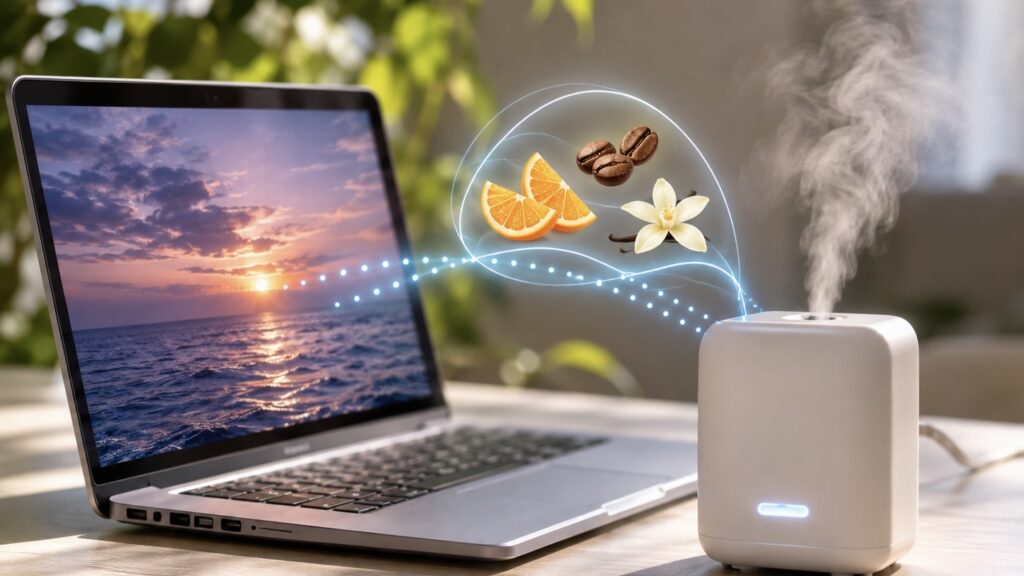
Sending photos from a smartphone, or video-calling someone far away.
These technologies are part of everyday life now, but what if we could send scent over the internet, too?
The aroma of coffee, or the fresh scent of fruit. A future in which we can share the same scent with someone far away may be closer than we think.
On October 21, 2026, a study offering a glimpse of that future was published in the journal Science Advances.
A research team including scientists from The Ohio State University developed a system called Scentronic, which uses AI to identify scents and recreate them in another location.
The researchers tested remote recreation of five different scents, and also reported promising results in experiments where people tried to identify the recreated scents.
In this article, we look at how this new research digitizes scent, what the experiments found, and how it might one day be applied to our daily lives.
Can Scent Be Sent over the Internet?
In our daily lives, we share all kinds of information through digital technology.
Photos and videos carry what we see, while phone calls and music streaming carry what we hear, across any distance.
Our sense of smell, on the other hand, has long been one of the hardest senses to digitize.
That is because a scent is made up of a great many chemical substances.
The aroma of coffee, for example, involves a large number of volatile compounds.
We perceive this complex combination of stimuli as a single thing: the smell of coffee.
Reading such complex scents with sensors, converting them into data and recreating them somewhere else is no simple task.
This is why a field of research called digital olfaction, which draws on AI and sensor technology, has been attracting attention in recent years.
The newly published Scentronic is one example.
How AI Identifies a Scent and Recreates It Elsewhere
Scentronic, developed by the research team, is a system that combines a device that detects scents with a device that recreates them.
The basic process can be divided into three main stages.
First, sensors detect the scent.
The system reads how the sensors respond to the chemicals in the scent and captures its characteristics as data.
Next, AI identifies the type of scent.
It analyzes the data and determines which of the scents it has already learned the sample matches.
Finally, the scent is recreated in a distant location.
The identified information is sent over the internet, and a dedicated device on the receiving end releases the matching fragrance.
The important point here is that the scent molecules themselves are not being sent over the internet.
What is sent is digital information that represents the type of scent.
Fragrances are prepared in advance on the receiving end, and the device releases the one that matches the information, making it possible to share a scent remotely.
In other words, at this stage it is not a technology that can create any scent at will, but a system that identifies and recreates scents that have been prepared beforehand.
Five Scents Recreated, with People Identifying Them About 73% of the Time
The study used five scents that are familiar from everyday life.
• Coffee
• Orange
• Cake
• Beer
• Red wine
In the experiments, these scents were identified by AI and recreated by a dedicated device in a separate location.
The researchers also evaluated how accurately people could identify the recreated scents.
In an evaluation with 14 participants, the scents were reportedly identified correctly about 73% of the time.
The system’s response time was also tested, and under certain conditions it was about 0.6 seconds.
What makes this study interesting is that it brought detection, identification, data transmission and recreation together in a single system.
That said, the figure of about 73% comes from an experiment with a limited number of scents and a small group of participants.
It does not mean that the countless scents we encounter in daily life can be recreated with the same accuracy.
Accuracy may also vary depending on the strength and complexity of a scent and the environment in which the system is used.
For now, it is best seen as a technology still at the research stage on its way to practical use.
How Might Our Lives Change If We Could Share Scents?
If scents could easily be shared as digital information, it might open up new experiences in our daily lives.
Take online shopping, for example.
Today, when we buy perfume or aroma oils online, we usually rely on product descriptions and reviews.
But if technology for recreating scents remotely becomes widespread, we might be able to experience a fragrance before we buy it.
Combining scent with video and music could also create more immersive entertainment.
Imagine a future where you can smell the trees while watching footage of a forest, or enjoy a scent that evokes a travel destination along with its scenery.
We can also imagine sharing the same scent with family and friends who live far away.
However, these are possible future applications, not services that this study has actually made a reality.
Before the technology can spread, there are many challenges to overcome, including making the devices smaller, cost, safety and the accuracy of scent recreation.
Even so, showing that smell could join the digital experiences we have so far shared through screens and speakers is a significant step forward.
The Value of Scent, and Time to Savor the Five Senses
Scent is part of so many moments in our daily lives.
The aroma of morning coffee can tell us the day has begun, and a familiar scent can bring back memories from the past.
Smell is one of the senses most closely connected to the areas of the brain involved in emotion and memory.
That is why scent is about more than simply enjoying a pleasant smell. It also shapes our experiences and impressions.
At La HEAD, too, scent is an important part of creating a soothing space.
Beyond the skill of our treatments, we care about the comfort you feel through all five senses, from lighting and sound to scent.
This study did not directly examine whether scent improves sleep or reduces stress.
Still, it shows that new possibilities are opening up even for smell, a sense that has long been difficult to digitize.
One day, we may be able to share our favorite scents with someone, no matter how far apart we are.
While we look forward to that future, why not take time now to cherish the scents around you and the comfort you feel through all five senses?