
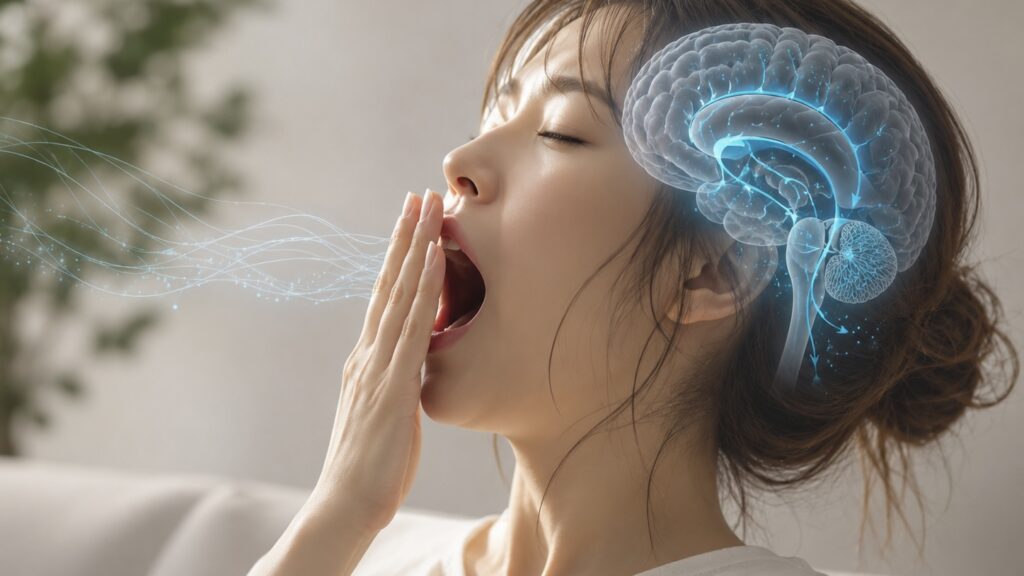
“You yawn because you’re not getting enough oxygen.”
Many people have probably heard this before.
However, there is currently not enough scientific evidence to support the “lack of oxygen” theory, and it is no longer considered a leading explanation.
In fact, even as of 2026, the true role of yawning has not been fully explained.
Even so, recent research is gradually revealing that yawning may be an important physiological phenomenon for our brains.
There Are Many Theories About Yawning
We yawn not only when we are sleepy, but in many other situations, such as
• When our concentration runs out
• Before or after a tense moment
• When we see someone else yawn
and more.
For this reason, researchers have proposed several theories, including that yawning helps
• Regulate the temperature of the brain
• Maintain alertness
• Serve as a form of social communication
among others.
In other words, yawning is thought to be a phenomenon that cannot be explained simply as “something we do because we are sleepy.”
A New Possibility from 2026 Research
An MRI study published in 2026 reported that yawning causes distinctive changes in the flow of cerebrospinal fluid (the fluid that surrounds the brain and spinal cord) and venous blood.
Based on these results, the researchers suggest that yawning may play a role in helping fluids circulate in the brain.
However, this study alone does not prove “the role of yawning.”
The researchers themselves say that further research will be needed to clarify how yawning works.
A Yawn May Be a “Signal from the Brain”
The true role of yawning has yet to be explained, but current research increasingly suggests that it may be a physiological phenomenon that helps regulate the state of the brain.
When you keep using your head for long hours at a desk, studying or on your smartphone, fatigue builds up in your brain without you even noticing.
If you keep yawning, it may be your body’s way of saying, “Please take a little break.”
Give Your Brain “Time to Rest,” Too
Even if we make a point of resting our bodies, we often have surprisingly little time to rest our brains.
At La HEAD, too,
“My head felt lighter after the treatment”
“I felt like my thoughts had been sorted out”
are some of the comments we hear from our guests.
Precisely because our days are so busy, it is important to make time to relax not only the body but also the brain.
Research into the role of yawning is still ongoing, but making a point of not letting brain fatigue pile up may be the first step toward keeping both mind and body in good condition.