
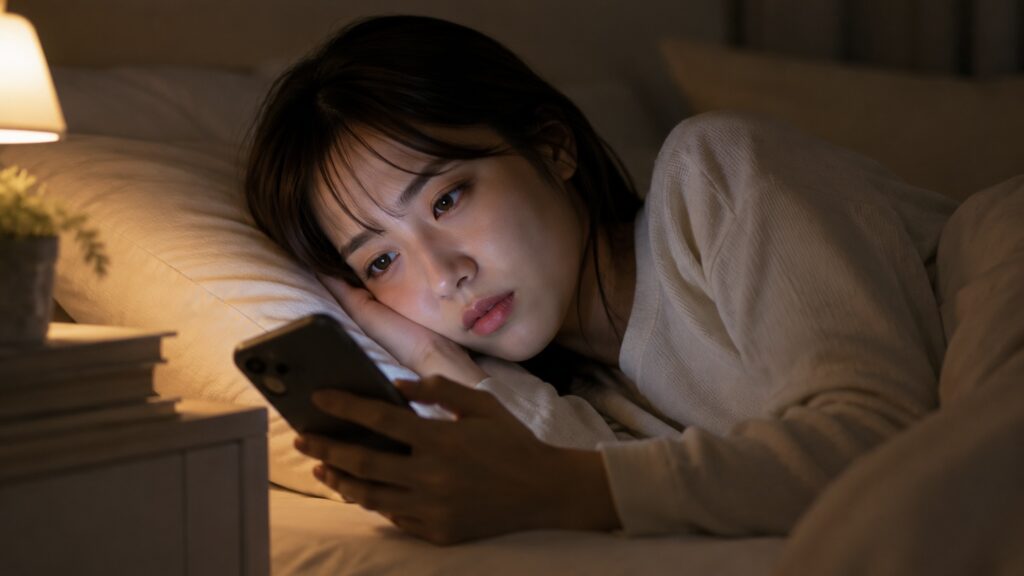
Before bed, you check the news for just a moment.
When you finish one article, related stories appear.
You tell yourself, “Time to sleep,” but read one more. Then the next one catches your eye, and before you know it you have been on your phone for more than 30 minutes.
And what you are reading is mostly news about crimes, disasters, the economy, war and social unrest—hardly the kind of thing that lifts your mood.
Why do we keep reading information we already know will make us feel worse?
In recent years, this behavior has come to be called “doomscrolling,” and it has even become a subject of research.
What Is Doomscrolling?
Doomscrolling generally refers to repeatedly seeking out negative news or anxiety-inducing information and continuing to scroll through it.
The word “doom” suggests ruin or an ominous fate.
Now that smartphones and social media are everywhere, finishing one story simply brings up related posts, videos and other articles, one after another.
As a result, we live in an environment where the cycle of
Checking information
↓
Finding something even more concerning
↓
Checking again
easily keeps going.
The term spread widely during the COVID-19 pandemic and has since drawn attention in fields such as psychology and media studies.
A 2026 Review Analyzed 17 Studies
A scoping review published in 2026 brought together 17 empirical studies that reported on doomscrolling.
These studies have reported links between how much people doomscroll and anxiety, stress and psychological distress.
In other words, people who spend longer following negative information tend to carry a heavier psychological burden.
But here is an important point.
From these studies alone, we cannot conclude that
“reading bad news made people anxious”
in a simple, one-way cause and effect.
It is also possible that people who were already more anxious or stressed check information about threats more often, and end up doomscrolling more as a result.
For now, it is most accurate to say that the two have been shown to be related.
Why Does Bad News Grab Our Attention?
Humans tend to pay more attention to negative information, such as danger and threats.
In psychology, this is known as “negativity bias.”
For example, when we think,
“What is going to happen next?”
“Could this affect me, too?”
“Has this turned into a bigger problem?”
we want to look for more information so we can feel reassured.
But along the way, we come across news that makes us even more anxious.
Then it becomes easy to fall into a loop:
Anxious, so you check
→ You learn new negative information
→ You feel uneasy again
→ You check even more
And around it goes.
What makes this topic so interesting is that we are not reading because it is enjoyable—sometimes it is precisely because we feel anxious that we find it hard to step away.
Reading the News Is Not the Problem in Itself
Of course, there is no need to avoid the news altogether.
Staying informed about disasters, current affairs and news related to your work is important.
The question to ask yourself is this:
“Am I reading to get the information I need?”
or
“I already know enough, but I just can’t stop?”
That is the difference that matters.
In particular, opening the news or social media in bed right before sleep can lead you to follow one story after another.
If that sounds familiar, you might try:
Deciding in advance when you will read the news.
Closing the app once you have checked what you need.
Not looking at news or social media right before bed.
Keeping your phone out of arm’s reach.
Creating your own way to stop the flow of information like this is one option.
Make Time for “No New Information” on Purpose
Today, simply opening your phone lets you follow events around the world almost in real time.
News on your commute.
Emails and chat messages at work.
Social media on your break.
Videos when you get home.
And news right up until bedtime.
For all the convenience, unless we are mindful, we live in an environment where new information can keep reaching us from morning until night.
That is why, going forward, resting may mean more than simply keeping the body still—
“making time to take in no new information”
may matter, too.
At La HEAD, in a calm, fully private room, you step away from your computer and phone, close your eyes, and receive slow, unhurried care not only for your head but also for your neck, shoulders and arms.
Precisely because information is available at any moment, you do not need to keep up with all of it.
Separate “time to stay informed” from “time away from information.”
If you find yourself unable to stop reading bad news even when you want to, why not start by consciously setting aside time to put your phone away?