
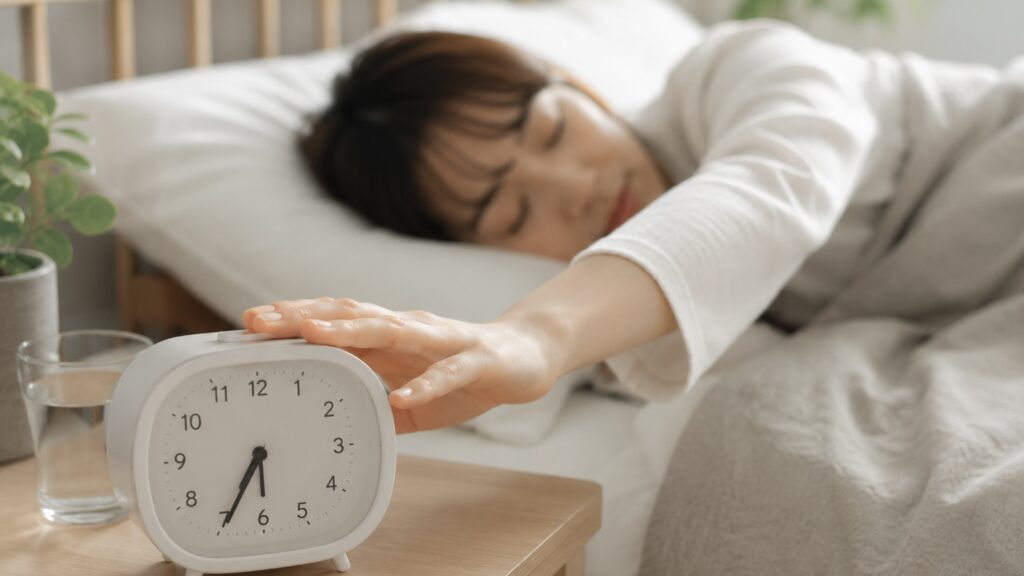
Your alarm goes off in the morning.
You turn it off: “Just five more minutes…”
Then the alarm rings again, and you hit snooze once more.
Many of us probably have mornings like this.
“Snoozing is bad because it breaks your sleep into pieces.”
“It’s better to get up the first time instead of dozing back off.”
You may have heard advice like this.
So should we really give up the snooze button?
In fact, recent research has reported the interesting finding that a short snooze isn’t necessarily a bad thing.
A Survey of More Than 1,700 People About Snoozing
In 2023, a research team including Stockholm University published a study in the Journal of Sleep Research examining snoozing habits and their effects on sleep.
The research was carried out in two stages.
First, the team surveyed 1,732 people about how they wake up in the morning and whether they use the snooze function.
The most common reasons people gave for snoozing were “I’m too tired to get up,” “I want to enjoy a little more sleep,” and “I want to wake up slowly”, among others.
The study also reported that snoozers tended to be younger than non-snoozers, and that many of them were evening types (night owls).
The team then ran an experiment to see how sleep and the state after waking actually change when people snooze.
Comparing a “30-Minute Snooze” with Getting Up Right Away
The experiment involved 31 people who habitually use the snooze function.
Participants experienced both
a morning with 30 minutes of snoozing
and
a morning of getting up at the first alarm
, and the researchers compared their sleep and their cognitive function after waking.
On snooze mornings, participants didn’t sleep straight through the 30 minutes; the alarm woke them up partway through.
The results showed that while snoozing fragmented the last 30 minutes of sleep, the actual sleep lost was only about 6 minutes on average.
What’s even more interesting is how people felt after waking.
Snoozing Led to Better Results on Some Cognitive Tests
In the study, participants completed several cognitive tasks after waking, such as arithmetic and memory tasks.
Right after snoozing, performance on some cognitive tests improved, or at least did not get worse, the researchers found.
There was also no clear negative effect on mood or sleepiness.
The researchers suggest this may be related to snoozing reducing the chance of being jolted awake from deep sleep, making it easier to wake from lighter sleep.
That state right after waking up in the morning,
“My eyes are open, but my brain isn’t working yet,”
is known as sleep inertia.
For some people, then, a short snooze may make this “switch from sleep to wakefulness” a gentler one.
That Doesn’t Mean You Can Doze Back Off as Often as You Like
This point is important.
This experiment looked at 31 habitual snoozers who snoozed for 30 minutes.
So this research does not show that
“Everyone should snooze.”
“Dozing back off for an hour is no problem.”
“Setting off the alarm again and again has no effect on sleep.”
None of these claims are supported by the study.
Research on snoozing itself is still limited, and the effects of repeated alarms on sleep fragmentation and on how we feel after waking need further study.
In particular, if you can’t get up without hitting snooze many times every morning, whether you’re getting enough sleep in the first place is an important question to ask yourself.
You Don’t Have to Label Snoozing as “Bad”
Based on this research,
it seems there’s no need to see a short snooze, in itself, as necessarily a bad habit.
If mornings are hard for you, waking gradually with a short snooze may suit you better than forcing yourself to leap out of bed at the first alarm.
On the other hand, if your mornings look like this,
Staying up late
↓
Not getting enough sleep
↓
Being unable to get up in the morning and hitting snooze again and again
then the real issue may not be snoozing but a lack of sleep at night.
At La HEAD, in a calm, fully private room, you can step away from your computer and smartphone, close your eyes, and let us slowly care for not just your head but your neck, shoulders, and arms.
When thinking about sleep, too, it’s important not to focus only on one habit, judging snoozing as simply “good” or “bad,” but to consider everything from how long you sleep at night to how you wake up in the morning.
There’s no need to feel overly guilty, thinking “I dozed off again…”
Why not learn to work well with a short snooze, and find a way of waking up that lets you start the day feeling good?