
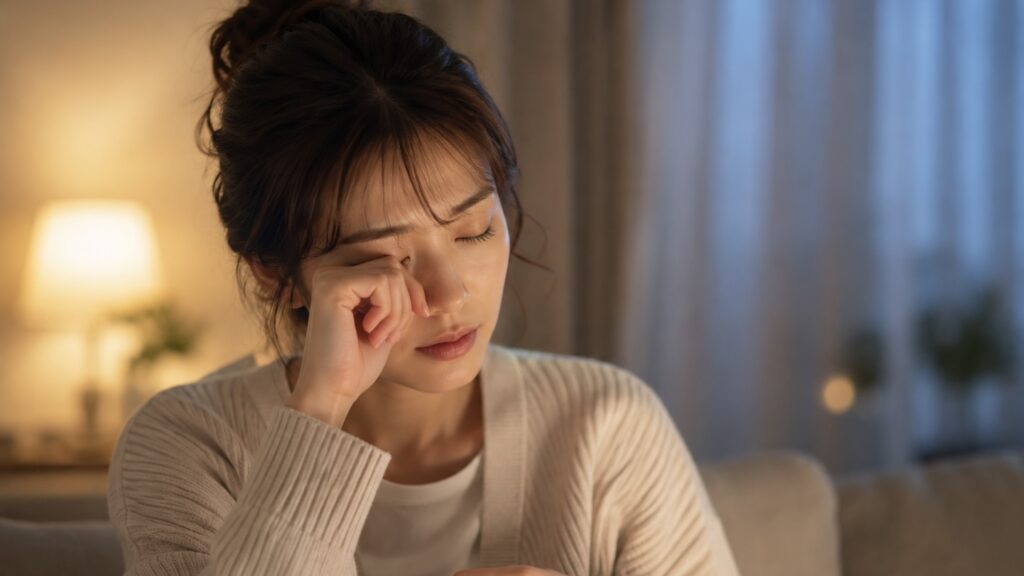
When sleepiness creeps in, we start rubbing our eyes without even thinking.
We often see sleepy children rubbing their eyes, but adults, too, tend to touch the area around their eyes while working or late at night.
It’s such a natural behavior that
“I rub my eyes because I’m sleepy”
seems perfectly obvious, but why do sleepiness and eye rubbing go hand in hand?
In fact, science has not pinned down a single cause for the behavior itself, that is, why we rub our eyes when we get sleepy.
Research does show, however, that sleepiness and lack of sleep bring changes to the surface of the eye, to our tears and to the way we blink.
Does Lack of Sleep Reduce Your “Tears”?
First, the relationship between lack of sleep and tears is quite intriguing.
In 2014, a research group in South Korea studied 20 healthy men to see how sleep deprivation affects the surface of the eye and tears.
The results showed that the next morning, tear secretion had decreased in the sleep-deprived group.
In addition, the “tear film” that covers the surface of the eyeball stayed stable for a shorter time.
Tears are not only something we shed when we’re sad.
They constantly form a thin layer over the surface of the eyeball and
prevent dryness
protect the surface of the eye
keep it smooth
among other important roles.
So when lack of sleep changes the condition of your tears, it may lead to a feeling of dryness or discomfort in the eyes.
“On days when I haven’t slept enough, my eyes feel kind of bleary.”
Changes like these in the eyes may be behind that feeling, too.
Your “Blinking” Changes When You’re Sleepy, Too
Tears aren’t the only thing that changes with sleepiness.
Changes also show up in the way you blink.
In a study of 129 people, as sleepiness grew stronger, changes were seen in the duration of blinks and in how the closed eyelids reopened, among other things.
It may be easiest to picture someone who becomes drowsy while driving a car.
A blink that would normally be over in an instant
“closes slowly,”
“stays closed longer,”
“looks heavy-lidded,”
gradually turning into something like this.
These movements of the eyes and eyelids are also being studied as indicators for objectively measuring sleepiness.
In other words, the feeling of “heavy eyes” isn’t just your imagination; the movements around your eyes really do change as you get sleepy.
So Why Do We “Rub”?
This is the most interesting part of the story.
Research has examined how lack of sleep leads to changes like these:
the condition of your tears changes
↓
your eyes feel dry or uncomfortable
↓
sleepiness makes your eyelids heavy
These changes have been studied.
However,
“and that’s why humans came to rub their eyes”
has not been directly proven.
Rubbing your eyes sends strong sensory input to the skin and the area around the eyes, so you may feel temporarily “refreshed” or “a bit more awake.”
People also tend to touch their faces or foreheads unconsciously when they feel tired or stressed, a behavior known as self-touch.
So rubbing your eyes when you’re sleepy
may be the result of several factors overlapping, such as dry or uncomfortable eyes, heavy eyelids and unconscious self-touch when you’re tired.
In other words, even the eye rubbing we do so casually still holds parts that aren’t fully understood.
Even If It Feels Good, Be Careful with Rubbing
Rubbing your eyes may feel good for a moment, but making a habit of rubbing hard is not recommended.
The skin around the eyes is very thin and easily irritated by friction.
Pressure is also applied to the eyeball itself.
Especially if you have symptoms such as
“my eyes are always itchy,”
“they feel gritty,”
“they keep feeling dry,”
“my eyes are red,”
it may not be simple sleepiness; another cause, such as dry eye or allergies, may be involved.
In that case, rather than rubbing them, consult an eye doctor if needed.
And if you catch yourself rubbing your eyes while working,
“It’s time to rest my eyes and mind.”
You might use it as a cue to take a break.
Look away from your screen.
Gaze into the distance.
Close your eyes for a little while.
Even for a short time, try to take a break from visual information.
Give Your Hard-Working “Eyes and Mind” a Rest
You wake up and look at your smartphone.
You look at a screen on your commute.
You use a computer at work.
You check social media on your breaks.
You watch TV or videos after you get home.
In modern life, our eyes and minds keep processing vast amounts of visual information all day long.
Even the casual act of rubbing your eyes when you’re sleepy could be a chance to notice, “I’m a little tired today.”
At La HEAD, you can close your eyes in a calm, fully private room while we care for not only your head but also your neck, shoulders and arms as one connected whole.
There’s nothing you need to look at and nothing you need to think about.
Step away from work and your smartphone, simply close your eyes and let your body relax.
That is the kind of time we value.
Precisely because your eyes and mind are looking at so many things every day, why not consciously make some “time when you don’t have to look at anything”?
We look forward to welcoming you.