
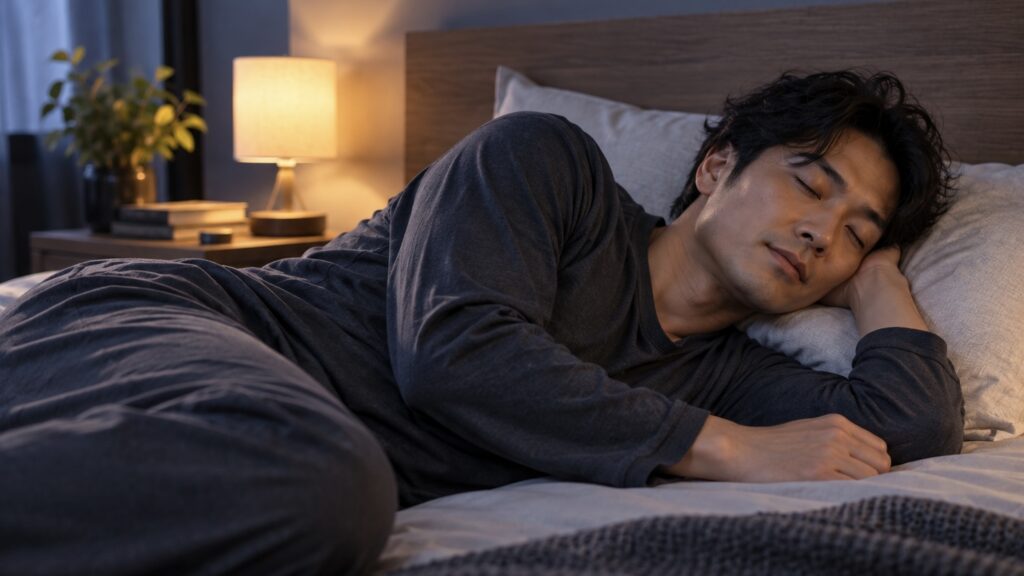
Lately, “recovery wear” has become a more common sight in sporting goods stores and department stores.
Some products claim to “support recovery from fatigue just by wearing them to bed” or to “support rest,” and many people may be curious about them.
On the other hand, there are questions such as:
“How is it different from ordinary pajamas?”
“Does just wearing it really make a difference?”
“Isn’t it all in the mind?”
These are fair questions to ask.
In fact, in recent years there has been research in which people actually wore and slept in clothing made with fibers that emit far-infrared radiation, the kind also used in some recovery wear.
Here, based on the research published so far, we consider whether recovery wear is really worth it.
What Is Recovery Wear in the First Place?
There are many kinds of products called “recovery wear.”
One type is clothing designed to make use of the infrared energy released by the body, with special minerals or other materials blended into the fibers.
What is important, however, is that not every product called “recovery wear” works the same way. Keep that in mind.
Materials, construction and far-infrared emission properties differ from product to product.
For that reason, research results for clothing made with one particular special fiber cannot simply be applied to all recovery wear.
So what have actual studies found?
A 2026 Study Found a Difference in “REM Sleep”
In a study published in Sensors in 2026, 15 healthy young men took part, and the researchers examined how clothing that emits far-infrared radiation affects sleep and body temperature regulation.
The study was a randomized, double-blind, placebo-controlled crossover trial.
On separate nights, the participants slept in both
clothing that emits far-infrared radiation and
control clothing made to look the same
They wore each of the two.
In other words, it compared the two while keeping as low as possible any effect from people being aware that they were wearing special clothing.
The results showed that on nights when participants wore the far-infrared clothing, eardrum temperature during the night was lower, and sweating in the middle of the night was also reduced.
What is even more interesting is the effect on sleep.
The proportion of REM sleep was 22.2% with the far-infrared clothing, compared with 18.6% with the control clothing.
The difference was statistically significant.
REM sleep is known as the sleep stage in which we tend to dream, and researchers are also studying its links with memory and emotional processing.
However,
“more REM sleep = better sleep quality”
cannot be assumed so simply.
In fact, in this study, there was no significant difference in total sleep time or sleep efficiency.
In other words, while the far-infrared clothing may have brought some changes in body temperature regulation and part of the sleep structure during sleep, it has not been proven that people slept better.
A 2023 Study Found No Clear Difference in “Sleep Quality”
Another useful study was published in 2023 in the International Journal of Environmental Research and Public Health.
Researchers from The Hong Kong Polytechnic University and The University of Hong Kong carried it out with 40 adults aged 18 to 65 who had trouble sleeping.
The participants were randomly divided into
a group wearing pajamas that emit far-infrared radiation and
a group wearing sham pajamas without the far-infrared function
, and the two were compared for six weeks.
This trial, too, was designed so that the participants did not know which pajamas they were wearing.
To assess sleep, the researchers used the widely used PSQI (Pittsburgh Sleep Quality Index).
The results were a little surprising.
After six weeks, PSQI scores improved in both groups.
However, no statistically significant difference in sleep quality was found between the far-infrared pajamas and the control pajamas.
In other words, it could not be said that
“wearing special pajamas clearly improved sleep quality more than ordinary pajamas.”
That was the conclusion.
On the Other Hand, an Interesting Result for “Physical Fatigue”
The 2023 study assessed not only sleep, but also fatigue.
It used the Multidimensional Fatigue Inventory (MFI), which assesses physical fatigue and other types of fatigue.
In the group that used the far-infrared pajamas, a large effect size was seen for improvement in physical fatigue compared with the control group.
However, it did not reach statistical significance.
The researchers themselves reached a cautious conclusion: it may improve physical fatigue, but more research is needed.
Since this was a small pilot study of 40 people, these results alone cannot be taken to mean that a fatigue-relieving effect has been proven.
Even so, it is a result worth further research.
So, Does Recovery Wear “Work”?
To sum up the current research, there is not yet enough scientific evidence to say for certain that
“wearing it will always relieve fatigue”
or “it will definitely improve sleep quality.”
That is where things stand.
On the other hand, it also seems too early to decide that
“it is exactly the same as ordinary pajamas, with no difference at all.”
That would be jumping to conclusions.
The 2026 study found that far-infrared clothing led to differences in nighttime body temperature regulation and the proportion of REM sleep.
The 2023 study did not find a clear effect on sleep quality beyond the control group, but it did show a result for physical fatigue that is worth testing further.
At this stage, it seems best to see it this way:
Recovery wear is not “magic pajamas that restore your body just by wearing them.”
But research is gradually advancing on whether it may affect the body’s environment during sleep.
That is probably the most sensible way to think about it.
Above all, what matters more than wearing recovery wear is getting the sleep you need, keeping a steady daily rhythm, and making your bedroom and bedding suit you.
Once those basics are in place, it seems realistic to think of the clothes you wear each night as an “extra” option.
As more studies with larger numbers of participants and longer durations appear, it may become clearer which materials help, for whom and by how much.
At La HEAD, we will keep explaining everyday questions about sleep and rest in clear terms, based on research.