
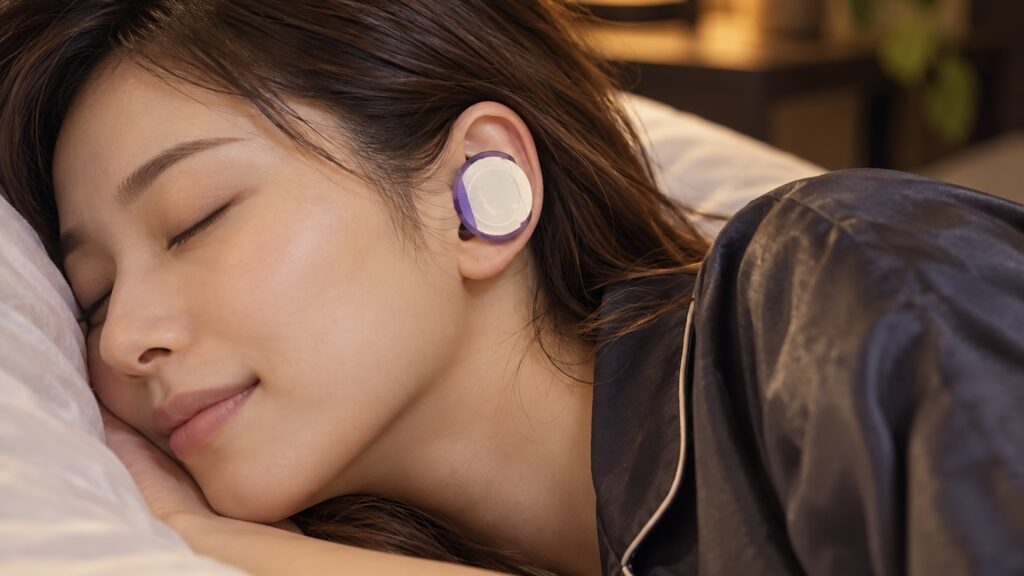
Gently warming your ears before bed: “ear warming”
These days, you see more and more products designed to warm the ears.
Among them, Kobayashi Pharmaceutical’s Nightmin Mimi Hogu Time (a self-heating ear warmer) had passed roughly 4 million units in cumulative sales as of September 2026.
A renewed version with built-in earpieces went on sale on October 1, 2026, drawing fresh attention. The product uses a dedicated heating element and is designed to provide warmth of about 40°C for about 20 minutes.
So,
“Does warming your ears really make it easier to fall asleep?”
In this article, we look at what current research tells us about ear warming and sleep.
A study that warmed the ears at about 40°C for 20 minutes
There is a small study that looked at how the body changes when the ears are warmed.
In a trial published by Kobayashi Pharmaceutical in 2022, 10 healthy men and women in their 20s to 40s had their outer ears warmed to about 40°C for 20 minutes.
As a result,
• Subjective feelings of relaxation increased
• Skin temperature on the back of the hand increased
• Salivary sIgA concentration increased
These were the changes reported.
sIgA is an immune substance found in saliva and elsewhere, and in this study it was measured as one indicator related to comfort.
In other words, the study suggests that warming the ears may change how relaxed people feel and the temperature of parts of the body.
However, this study comes with important caveats.
It involved only 10 participants, and it was conducted by a company.
In addition, it did not measure things such as
how long it actually takes to fall asleep
total sleep time
deep sleep
waking during the night.
For that reason,
“Warming your ears improves sleep”
is not a conclusion we can draw from this study alone.
“Warm ears help you sleep” has not been proven yet
If you search for ear warming online, you may come across claims such as
“It balances your autonomic nervous system”
“It makes your parasympathetic nervous system dominant”
“It helps you fall asleep faster”.
However, at this point, we have not been able to find clinical studies of sufficient size and quality showing that simply warming the ears improves the time it takes to fall asleep or the quality of sleep.
Even including research outside Japan, studies on the ears have focused mainly on acupressure of the outer ear and electrical vagus nerve stimulation.
These methods are different from
“applying heat of about 40°C to the ears,”
so their results cannot simply be used as evidence for ear warming.
Based on the current science, it is fair to say that
warming the ears may help you feel relaxed, but improved sleep has not been established.
Research does link “warming part of the body” with sleep
On the other hand, there is interesting research on localized warming and sleep at places other than the ears.
In 2020, a research team including Nihon University School of Medicine conducted an experiment with 18 healthy adults in which the area around the eyes was warmed before bedtime.
When a heated eye mask was compared with a sham eye mask that did not actually warm up,
warming the eyes shortened the time it took to fall asleep, and also increased stage 2 sleep and delta activity in brain waves during the first half of the night.
In addition, a 2019 study found that warming the area around the eyes to about 38–40°C raised the skin temperature of the hands and feet.
Because the temperature at the core of the body did not change, the findings suggest that localized warming may have triggered a response similar to the physiological change before sleep, in which heat is released through the hands and feet.
This is not the simple mechanism of “warming raises your core temperature and makes you sleepy.”
Rather, before sleep, blood flow to the hands and feet increases, and as heat from inside the body is released outward, core body temperature falls.
This change in body temperature is involved in the transition to sleep.
Warming the eyes also made a difference for people with insomnia
A 2022 study involved 22 people with sleep problems and 16 people diagnosed with insomnia.
When the area around the eyes was warmed before bed, compared with a sham eye mask, the time to fall asleep, measured by brain waves, became shorter.
What’s more, the greater the heat released from the hands and feet, the more strongly it was linked to falling asleep faster.
In 2024, a study of 64 women with sleep problems was also conducted:
a randomized controlled trial of warming the eyes before bed for 4 weeks.
Compared with the sham group, the warming group showed improved scores on an insomnia symptom scale, as well as improvements in subjective time to fall asleep and the feeling of being refreshed by sleep.
There is also a report, from a very small study of just 8 people, that warming the eyes or the back of the neck to about 40°C changed subjective sleep and brain waves during the first half of sleep.
In other words,
there is a certain body of research on localized warming and sleep itself.
However, these studies warmed the eyes or the neck.
We cannot simply assume that “the same thing happens with the ears.”
Ear warming is best thought of as “relaxation time before sleep”
To sum up the current research,
warming the ears may change feelings of relaxation and skin temperature
On the other hand,
it has not yet been sufficiently proven that warming the ears alone improves how quickly you fall asleep or the quality of your sleep
That is where things actually stand.
For Nightmin Mimi Hogu Time as well, Kobayashi Pharmaceutical lists not only the warmth but also the earpieces that soften surrounding noise as features of the product.
So rather than thinking about a single effect, as in
“I can sleep because my ears are warm,”
it may be more natural to think that the whole experience of
feeling the warmth
reducing the noise around you
stepping away from your smartphone
and spending about 20 minutes quietly
becomes a time to relax before bed.
Sleep research also shows that the body does not suddenly switch from “ON to OFF” like a power switch.
Many factors, such as light, sound, body temperature and stress, shift as you gradually move into a sleeping state.
Instead of working or scrolling social media right up until bedtime,
“From here on, it’s time to rest.”
Make that kind of cue a habit.
Ear warming may be a nice way to add one more step to that kind of pre-sleep routine.
At La HEAD, too, we carefully treat the head, neck and shoulders in a quiet, fully private room.
Amid your busy days, we hope you will make a point of stepping away from information and creating time to switch your body and mind into rest.