
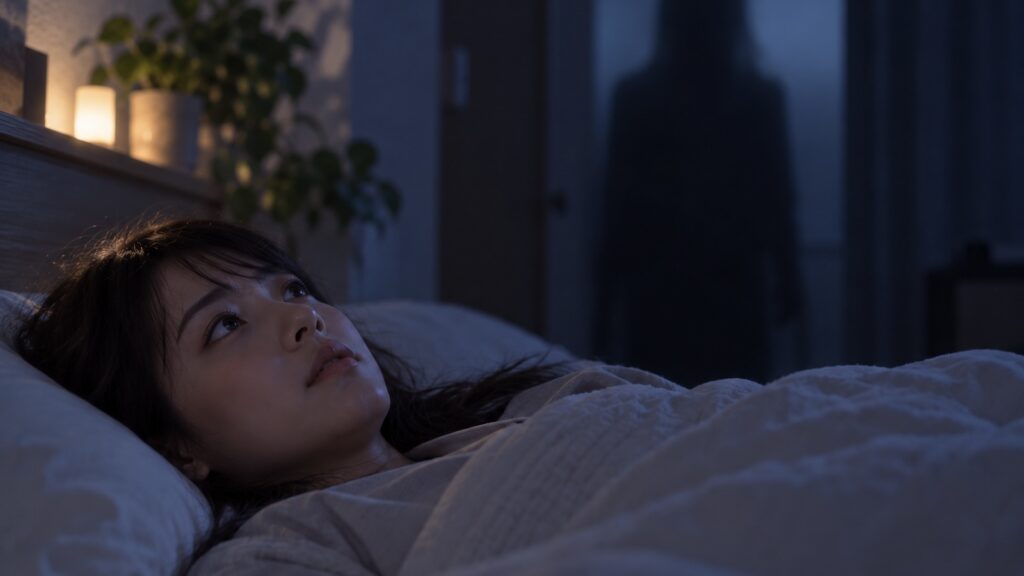
You suddenly wake up in the middle of the night.
Your mind is perfectly clear, yet your body will not move. You try to call out, but no sound comes.
And sometimes—
“Someone is in the room.”
“I can see a figure.”
“Something is coming closer.”
You may feel that kind of terror.
This is what is commonly known in Japan as kanashibari.
Long described as a supernatural phenomenon, it is studied in sleep science today as “sleep paralysis.”
So why does it not only leave you unable to move, but also create that strange sense that “someone is there”?
What It Really Is: Sleep Paralysis
Sleep is broadly divided into “non-REM sleep” and “REM sleep.”
The stage most closely linked to sleep paralysis is REM sleep.
During REM sleep, the brain is relatively active, and vivid dreams are more likely.
Meanwhile, the body goes through a very distinctive change.
That change is the strong suppression of skeletal muscle activity.
In dreams, we may run or fight something. Even so, during REM sleep our muscles are kept in a state where they cannot easily tense, so that our actual body does not act out those movements.
Normally, this state switches off when we wake up.
In sleep paralysis, however, the timing can slip slightly out of step.
Your mind is awake, but your body is still in the “unable to move” state of REM sleep.
That is the basic mechanism behind sleep paralysis.
Why Do You Feel “Someone Is There”?
What makes sleep paralysis even more mysterious is that it involves more than just being unable to move.
You see a figure.
You hear voices or footsteps.
You feel as if something is pressing down on your chest.
And you sense that someone is in the room.
These experiences have been studied as hallucinations and a “sensed presence” that accompany sleep paralysis.
A study published in 2019 surveyed 185 people who had experienced sleep paralysis and reported that 57.84% had experienced a sensed presence—the feeling that “someone is in the room”—during sleep paralysis.
In other words, the sense that “someone is there” is by no means unusual among people who have experienced sleep paralysis.
In addition, a systematic review published in 2024, covering 76 studies and 167,133 people, also reported that sleep paralysis can be accompanied by hallucinations, such as visual and auditory ones.
To the person experiencing it, it does not feel like a dream; it feels as though it is happening in their actual bedroom, which can make it an extremely real and frightening experience.
No Wonder It Can Feel Like Seeing a Ghost
Imagine it.
A dark bedroom in the middle of the night.
Your eyes are open. You are conscious.
And yet your body will not move at all.
On top of that, you see a figure in the corner of the room, or even sense someone close by.
In that state, if you knew nothing about sleep paralysis,
“Something is here.”
“A spirit is holding me down.”
it would be no surprise to think so.
In fact, interpretations of sleep paralysis vary from culture to culture, and around the world it has long been linked to supernatural beings.
Today, however, much of what people experience—“my body won’t move,” “I can see a figure,” “I sense someone there”—can be explained as a state in which sleep and wakefulness overlap.
That said, the detailed brain mechanisms behind why we so often sense a human presence in these hallucinations have not yet been fully explained.
Is Sleep Paralysis More Likely When You Are Short on Sleep?
Sleep paralysis can happen to healthy people, too.
At the same time, research has pointed to links with sleep deprivation, irregular sleep, stress, jet lag and similar factors.
One possible reason is that disrupted sleep hours or changes in the rhythm of REM sleep make the boundary between sleep and wakefulness less stable.
Some studies have also reported a link between sleeping on your back and sleep paralysis.
So if you experience sleep paralysis repeatedly, before worrying about “something supernatural,”
Have you been sleeping less lately?
Have your bedtimes and wake-up times become very irregular?
Has your daily rhythm changed?
it may be worth looking back on points like these.
However, if it happens frequently, if the fear makes you afraid to go to sleep, or if you also feel very sleepy during the day, it is best to consult a medical institution that specializes in sleep.
What Was Once Called a “Spirit,” Seen Through Science
Sleep paralysis itself is by no means a new phenomenon.
People long ago, too, likely had experiences such as
“I’m conscious, but my body won’t move.”
“Something is pressing on my chest.”
“Someone is in the room.”
just as we do.
Back then, however, neither REM sleep nor sleep paralysis was known.
So it may have been only natural to attribute these unexplainable phenomena to “spirits” or “the work of something unseen.”
Today, sleep science has come to understand that
Kanashibari = sleep paralysis
Being unable to move = the suppression of muscle activity during REM sleep still lingering
Figures and a sense of presence = hallucinations and a sensed presence that can accompany sleep paralysis
That is how far our understanding has come.
Of course, this does not mean science has proven whether supernatural beings exist.
But at the very least, it means that the distinctive experiences of sleep paralysis can be explained as a sleep phenomenon without assuming any spirits.
Suddenly being unable to move in the middle of the night is frightening, even if you know the science.
Even so,
“This might be sleep paralysis”
—simply knowing how it works may help you take it a little more calmly.
When we look at mysterious phenomena that have been talked about for ages through the lens of science, we find an even more fascinating world of human sleep hidden within.
At La HEAD, we will continue to share sleep-related folklore and everyday questions in an easy-to-understand way, based on research.