
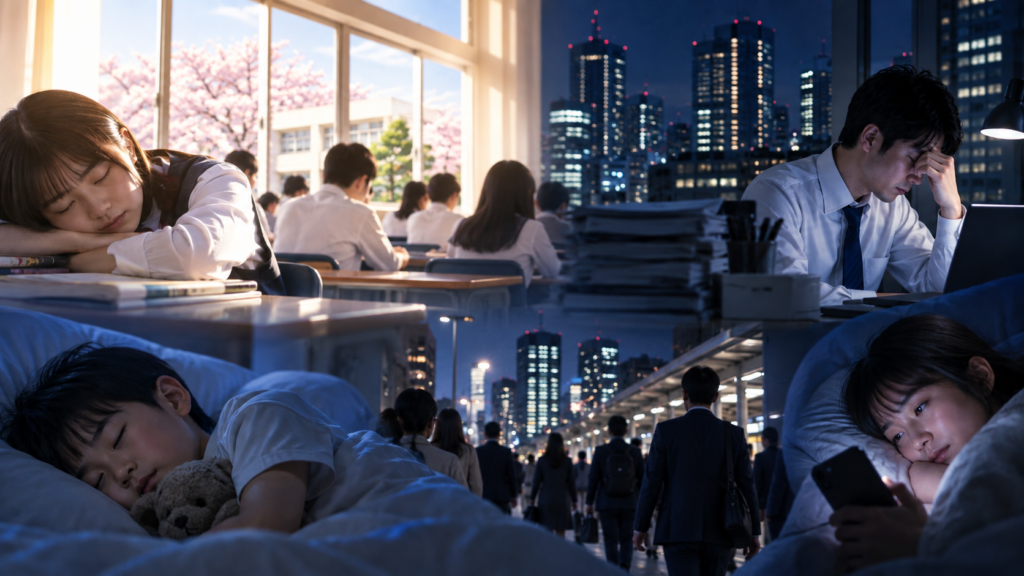
“I really should get more sleep.”
Even when we know this, busy days of work, housework or study mean we end up cutting back on sleep before we realize it. In Japan, a life like this is far from unusual.
In August 2026, Professor Masashi Yanagisawa of the International Institute for Integrative Sleep Medicine (WPI-IIIS) at the University of Tsukuba appeared in the CNN International feature “Japan’s sleep crisis: Can tech help?”
The feature was not simply about “tips for dealing with sleep deprivation.”
It looked at Japan’s sleep deficit as a social and cultural issue, focusing in particular on the sleep of children and young people, and how a culture that sees long working hours as a virtue affects sleep in Japan.
Japan’s Sleep Deficit Is Not Just a Personal Problem
“Just don’t stay up late.”
“Just spend less time on your phone.”
“Just go to bed earlier.”
Sleep deprivation tends to be seen as a problem of a person’s own lifestyle habits.
Of course, rethinking how we spend our days matters. But when the end of the workday or the start of the school day is fixed, there is a limit to how much time a person can freely adjust.
Even if you get home late, the time you need to get up the next morning stays the same. And so sleep is often the first thing to be cut.
Alongside the sleep technologies and latest research spreading in Japan, the CNN feature also examined how a culture that has long valued working long hours affects sleep.
To understand Japan’s sleep deficit, we need to look not only at “what time a person went to bed,” but at whether their life allows enough sleep in the first place.
Is Cutting Sleep to Work Harder Really Efficient?
In Japan,
“Study so hard you sacrifice sleep.”
“I’m busy, so I’ll cut back on sleep.”
“While you’re young, a little less sleep won’t hurt.”
These are the kinds of ideas you sometimes hear.
However, Professor Yanagisawa has long pointed out that cutting sleep to study is counterproductive, and that data show students who sleep well get better grades.
In a 2025 lecture Professor Yanagisawa gave at Ouin Gakuen, he also explained that lack of sleep has negative effects across a wide range of areas, not only academic performance but also insight, corporate performance, illness and immunity.
In other words,
“cutting sleep to increase your active hours”
=
“more time to get results”
is not necessarily true.
We need to consider not only how long we are awake, but also what state our brain and body are in during those hours.
“Go to Bed Earlier” Alone Cannot Solve Children’s Sleep
In this CNN appearance, one area Professor Yanagisawa particularly focused on was the sleep of children and young people.
Professor Yanagisawa explains that from adolescence through the twenties, the body clock shifts later, making people more likely to be night owls.
That is why, outside Japan, there are efforts not to change only the children, but to change the schools’ schedules as well.
In an American “Start School Later” example that Professor Yanagisawa has introduced, when a high school pushed its start and end times back by about two hours, students’ grades were reported to improve.
This is a fascinating point.
Rather than asking only children to make the effort—“study more,” “go to bed earlier”—it is about creating an environment that makes it easier to get enough sleep.
In his 2025 lecture at Ouin Gakuen, Professor Yanagisawa explained that the standard amount of sleep needed is about 9 hours and 15 minutes for junior high school students and about 8 hours and 15 minutes for high school students.
School, club activities, cram school, homework, smartphones—schedules run late into the evening, and they still have to get up early the next morning.
Children’s sleep deprivation, too, is a problem that cannot be explained simply by saying “they stay up late.”
Sleep Deprivation Also Affects Society’s Overall Performance
The effects of sleep deprivation are not limited to children’s grades.
In a sleep special on BS TV Tokyo in August 2026, in which Professor Yanagisawa appeared, “the ¥19 trillion economic loss caused by sleep deprivation” was also one of the topics.
It would not be accurate to treat this ¥19 trillion figure as something “Professor Yanagisawa calculated himself,” but it does show that sleep deprivation is not just a personal matter of feeling “sleepy” or “tired”; rather, it needs to be considered as an issue connected to learning, work and the productivity of society as a whole.
Professor Yanagisawa has also repeatedly explained how lack of sleep lowers brain performance, and its links to mental health problems, metabolic syndrome, dementia risk and more.
In his 2025 lecture at Ouin Gakuen, he also introduced another intriguing finding: that sleep deprivation suppresses altruistic behavior.
Sleep may not be a matter of our own individual health alone.
Studying, working, thinking, interacting with others.
Sleep is the foundation of the many activities we carry out during the day.
Before “How to Sleep,” Ask “Do I Have Time to Sleep?”
These days, we often see the phrase “sleep quality.”
Ways to improve your sleep environment, such as changing your bedding, taking a bath, dimming the lights and cutting back on your phone, are also important.
But before that, there is something to check.
Are you able to set aside enough time to sleep in the first place?
No matter how hard you try to improve the “quality” of your sleep, if you are not getting the amount of sleep you need, these efforts alone cannot make up for everything.
And securing enough sleep time is sometimes something individual effort alone cannot solve.
Working hours, school start times, how we spend time at home, and a social value system that has praised “cutting sleep to work harder.”
CNN International’s presentation of Japan’s situation to the world as “Japan’s sleep crisis” can also be an opportunity to think of sleep not only as a matter of personal self-management, but as an issue for society as a whole.
Before “How can I sleep better?” comes “Are we living lives that allow enough sleep?”
Whether for children’s learning or adults’ work, it may be worth taking another look at the very idea of “cutting sleep to work harder.”
At La HEAD, we will continue to share sleep research and the latest findings, including those of Professor Masashi Yanagisawa, in ways that are easy to bring into daily life.