
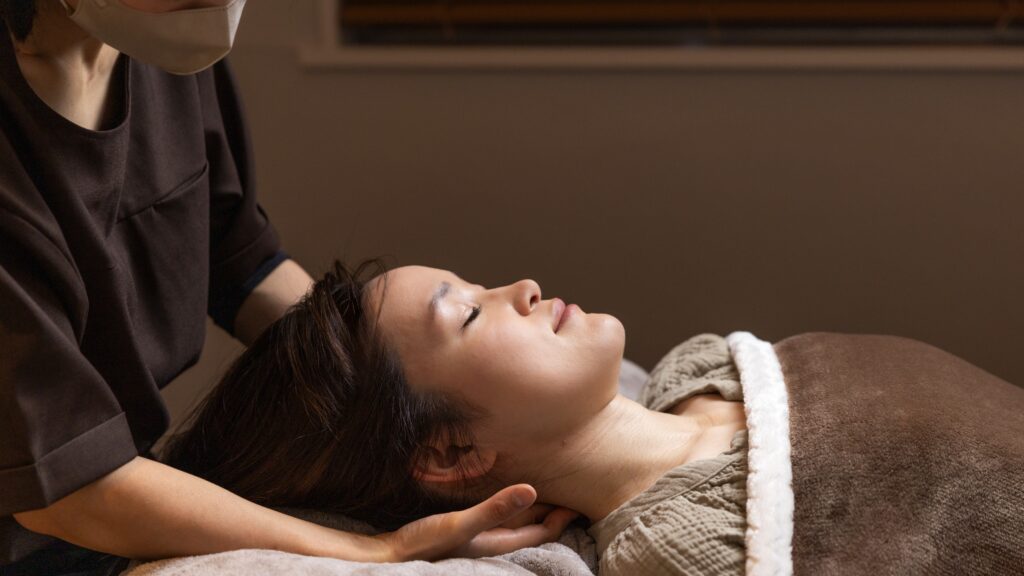
Having your hair shampooed at the salon.
Having a family member gently stroke your head.
And receiving a head massage.
When someone slowly touches your head, have you ever found yourself wanting to close your eyes, or felt the tension in your body suddenly melt away?
The feeling that “it’s so nice when someone touches my head” is something most of us know well.
In recent years, in fact, scientists have been exploring how being touched by another person affects the mind and body, and research in this area continues to grow.
And one large-scale study has reported some interesting findings about touch to the head in particular, compared with other parts of the body.
A Study of Touch Analyzing 212 Studies and About 13,000 People
In 2024, a German research team including Ruhr University Bochum and University Hospital Essen published a large-scale meta-analysis of touch interventions in Nature Human Behaviour.
It covered 212 studies and 12,966 people.
The study pooled and analyzed how a range of touch interventions, including massage, relate to physical and mental health.
It found that in adults, touch interventions led to improvements in several outcomes, including anxiety, depression, and pain.
Of course, this doesn’t mean that “any kind of touch will make everything better.”
The methods of touch, the people involved, and the study conditions varied widely.
Even so, results drawn from such a large body of research suggest that the act of being touched by another person may in itself mean more than just a physical sensation. That is the possibility these findings point to.
The Interesting Part: Where You’re Touched
What we at La HEAD find especially interesting are the results analyzing which part of the body was touched.
In adults, interventions that included touch to the head tended to have a greater effect on health outcomes than touch to the arms or torso, the analysis found.
The researchers also pointed to the possibility that face and scalp massage may be especially beneficial in their discussion.
Exactly why touch to the head showed this difference has not yet been clearly explained.
For that reason,
“touching the head will always be more relaxing than touching anywhere else”
is not something we can claim with certainty.
Still, it’s a fascinating finding when we think about the everyday feeling that “it’s so nice when someone touches my head.”
We Feel More Than Just “Where We Were Touched”
So what is actually happening in our bodies when someone touches us gently?
Our skin has ways of sensing all kinds of stimuli, such as pressure, vibration, and temperature.
And recent research on touch has been revealing that the sense of touch has not only
a side that recognizes “where we were touched”
but also
an emotional side, such as feeling “comfortable” or “safe.”
Both play a part in how we experience touch.
Among the nerve fibers known in particular to respond to slow, gentle touch are the C-tactile (CT) afferents.
Researchers are studying how this kind of pleasant touch information relates to the insula and other brain regions involved in emotion and body awareness.
In other words, the comfort we feel when someone touches our head isn’t simply a matter of
“pressure on the scalp.”
That physical stimulus alone can’t explain it; it may also have to do with how the brain receives and interprets that touch.
Is Touching Yourself the Same as Being Touched by Someone Else?
Another interesting question here is this:
“In that case, wouldn’t massaging my own head feel just the same?”
It’s a natural thing to wonder.
Of course, touching your own scalp can feel nice too.
But our brains predict, to a certain extent, the movements we make ourselves.
When someone else touches us, on the other hand, we can’t fully predict the timing, strength, or movement of the touch.
For this reason, it’s known that the brain processes touch differently depending on whether we’re touching ourselves or being touched by someone else.
“Rubbing my own head feels good, but it’s somehow different when someone else does it.”
This brain mechanism may be part of why so many of us feel that way.
There Are Many Reasons Something Feels Good
When people talk about why a head massage feels so good,
“because it loosens up the scalp”
is often the only explanation given.
But current research suggests it’s a bit more complex than that.
The pressure and movement on the scalp.
The sense of touch carried through the skin.
The feeling of being touched by another person.
The brain’s response to those sensations.
And a quiet setting where you can feel safe letting go.
It seems more natural to think that all of these elements come together to create the “feels so good” sensation we experience.
At La HEAD, in a calm, fully private room, we carefully care for not just the head but the neck, shoulders, and arms as one connected whole.
Stepping away from your computer and smartphone, closing your eyes, and instead of doing anything yourself, simply leaving your body in the therapist’s hands.
Perhaps the simple comfort of being touched by another person, something we rarely stop to notice, is itself one of the charms of a dry head spa.
That touch to the head that just “somehow feels good.”
Looking at the science behind that feeling may make your next head massage feel a little different.