
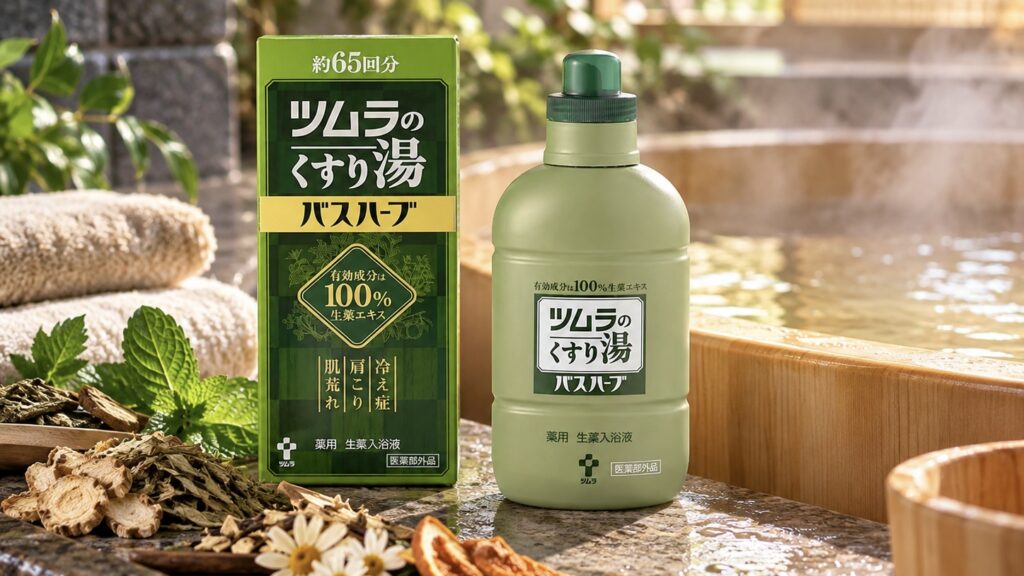
Lately, you may have seen it more often on social media: Tsumura’s medicinal bath, Bath Herb
With its green bottle and distinctive herbal scent, it is a little different from ordinary scented bath products.
Bath Herb, sold by Tsumura, is a medicated bath liquid classified as a quasi-drug in Japan.
According to official information, its active ingredient is an extract of six crude herbal medicines, and it is sold as a product that warms the body by enhancing the warming effect of a bath and promoting circulation.
In this article, we take a closer look at Tsumura Bath Herb, including the herbs it contains and the related research.
A “medicinal bath” with a history of more than 50 years
Bath Herb was born in 1975.
Its roots go back even further, however, to Yokuzai Chujoto, a bath product released in 1897.
According to Tsumura, the medicinal bath began when employees of its predecessor, Tsumura Juntendo, put the herb scraps and powder left over from making Chujoto (an herbal remedy) into their own baths.
Later, driven by the desire to create a bath product with solid scientific grounding, the company spent five years collecting and analyzing data during development, and today’s Bath Herb was launched in 1975.
Although it has been on the market for a long time, it is not simply a traditional herbal bath turned into a product; it is designed as a quasi-drug.
What’s inside? Six herbal ingredients
Bath Herb’s active ingredient is the “Bath Herb extract,” drawn from six herbs:
• Angelica root (toki)
• Cnidium rhizome (senkyu)
• Glehnia root (hamabofu)
• Citrus unshiu peel (chinpi)
• Japanese mint (hakka)
• Chamomile (kamitsure)
These six herbs make up the extract.
For example:
Angelica: the root of a plant in the carrot family
Chinpi: the peel of the satsuma mandarin
Japanese mint: a plant in the mint family
Chamomile: the flowers of German chamomile
These are some of the plant materials used.
The basic idea behind Bath Herb is to enhance the warming effect of the bath with this blend of herbal extracts.
The approved effects of the product include
Poor circulation and feeling cold
Stiff shoulders
Lower back pain
Recovery from fatigue
Rough, dry skin
as well as neuralgia, heat rash, eczema, and cracked or chapped skin.
What research exists on mint and chamomile?
There is also research on each of the plants and compounds contained in the formula.
Take, for example, menthol, found in mint.
Menthol is known to stimulate the cold receptor TRPM8 found in the skin and elsewhere.
This receptor responds to low temperatures and to menthol, which creates the cool, refreshing sensation typical of mint.
As for chamomile, a systematic review and meta-analysis of 11 randomized controlled trials was published in 2025.
It reported that chamomile interventions improved some inflammation-related symptoms and pain, suggesting possible anti-inflammatory effects.
However, it is important to keep these things separate.
These are findings from studies of menthol and chamomile themselves.
“If you soak in a Bath Herb bath, you will get the same effects”
is not something these studies have proven.
For the product, it is appropriate to consider its approved quasi-drug effects separately from the basic and clinical research on its individual ingredients.
Soaking in a bath has been studied in its own right
Apart from Bath Herb’s ingredients, there is also research on soaking in warm water itself.
In 2019, a research team including the University of Texas published a systematic review and meta-analysis of 17 studies on bathing, warm showers and sleep.
It found that taking a bath or shower at about 40–42.5°C one to two hours before bedtime was associated with better subjective sleep quality and sleep efficiency, and with falling asleep faster.
Even a relatively short bath of about 10 minutes tended to help people fall asleep sooner.
Why does a warm bath make it easier to fall asleep?
A bath temporarily warms the body, and afterward, blood flow to the hands and feet increases, making it easier for heat to escape.
As a result, core body temperature falls as bedtime approaches, which is thought to lead to natural sleepiness.
In a study of Japanese participants as well, soaking in a bathtub about 1.5 to 2 hours before bed, with body temperature dropping well between the bath and bedtime, led to falling asleep faster and better subjective sleep compared with showering only.
So even when you use Bath Herb,
it is not only the “herbal bath additive” that matters; the habit of soaking slowly in the tub
is meaningful in itself.
How to use it: more is not better
According to Tsumura’s official directions, add
3–10 mL of Bath Herb
to about 100–200 L of bath water.
Half a cap is about 10 mL.
“More will probably work better,”
you might think, but Tsumura advises using it according to the directions and dosage.
There are also precautions:
• Do not use it together with other bath products
• Consult a doctor if you have any skin or health concerns
• Stop using it if you develop a rash, redness, itching or irritation
These are among the points to keep in mind.
Because of its distinctive herbal scent, it feels quite different from typical floral bath products.
If you enjoy the scent of a traditional herbal bath, it may be especially enjoyable for you.
At the end of a busy day,
step away from your smartphone, soak in the tub and warm your body.
Add the scent of herbs to that.
Why not bring this kind of time-honored self-care into modern life?
At La HEAD, when we think about sleep and fatigue, we value not just “the moment right before bed” but making time at the end of the day to switch your body and mind into rest.
We also recommend using your bath not just as a place to wash, but as time to release the tension of the day.