
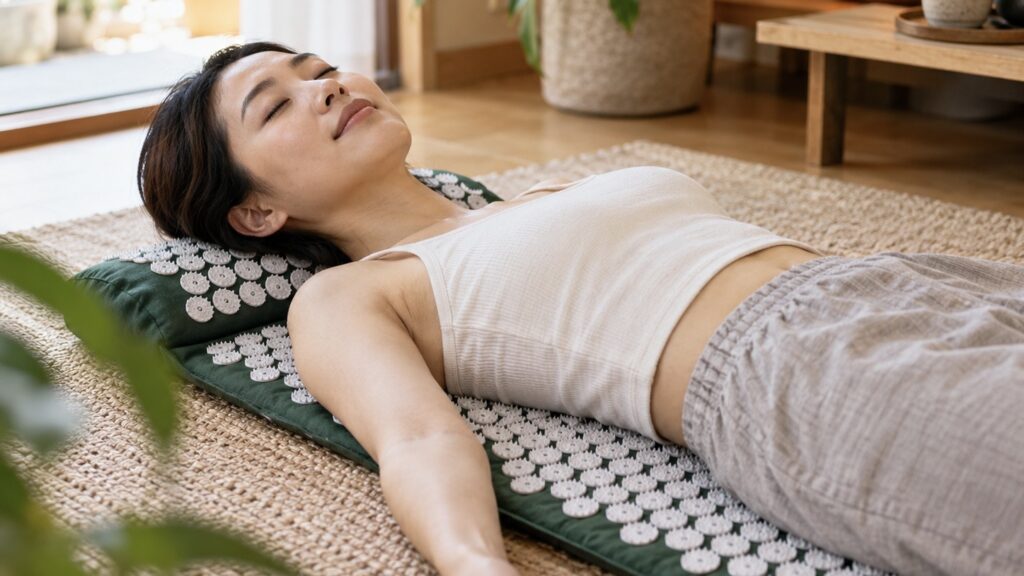
You lie down on a mat covered in rows of sharp spikes:the “Shakti Mat (ShaktiMat)”.
Lately, on social media and elsewhere,
“It helps me relax before bed.”
“I’ve started sleeping better.”
“My neck and shoulders feel easier.”
you may have come across comments like these.
It certainly looks intense, but has it actually been studied scientifically?
In fact, there is research that used the ShaktiMat itself.
To give the conclusion first, however,
while several physiological changes in the body have been confirmed, no special effect on sleep or stress has been established.
In this article, we look at the Shakti Mat through the results of actual research.
What Happens to Sleep and Stress After Three Weeks on a Shakti Mat?
A relatively recent study, published in Applied Psychology: Health and Well-Being in 2024, comes from Osnabrück University in Germany and the Norwegian University of Science and Technology .
Sixty-two healthy young adults took part.
The participants were divided into
a group that relaxed using a Shakti Mat and a group that lay down and relaxed in the same way without using anything .
Both groups did this for 20 to 30 minutes before bed at night, three times a week, for three weeks.
The results showed
reduced stress
improved subjective well-being
improved sleep quality
improved concentration
across the board.
Looking at this alone,
“So the Shakti Mat really is good for sleep and stress, right?”
you might think.
What is critically important, however, is that similar improvements also occurred in the group that did not use a Shakti Mat .
For blood pressure, heart rate, and pain threshold and tolerance as well, no special changes were found only in the Shakti Mat group.
The researchers also point out that, in healthy young people, what may have made the difference was not the Shakti Mat itself, but regularly setting aside time to relax in a quiet environment .
Note that in this study, ShaktiMat provided 60 mats for research use, but the paper states clearly that the researchers received no financial compensation.
Does Lying on a Shakti Mat Change the Autonomic Nervous System or Blood Flow?
Another interesting study was published in 2011.
In this study, 32 healthy adults lay on a Shakti-mat with 6,210 spikes , and their heart rate, blood pressure, heart rate variability (HRV), breathing, salivary cortisol and more were measured.
As expected, pain rose sharply at first when they lay down on the mat.
However, the pain peaked at about 30 seconds and then gradually declined.
A response resembling “adaptation,” in which the body gets used to the stimulus, was observed.
Physiologically,
a lower heart rate
an increase in high-frequency HRV
findings indicating increased circulation in the back
and other changes were confirmed.
Blood pressure, on the other hand, actually rose, and the researchers describe the response during Shakti Mat use as showing activity of both the sympathetic and parasympathetic nervous systems .
In other words,
“Lie on a Shakti Mat, the parasympathetic system takes over, and your autonomic nervous system comes into balance.”
explaining it that simply is not accurate.
The body’s reaction to the sharp stimulus and the process of getting used to it may be happening at the same time.
In addition, for salivary cortisol, known as a stress hormone, there was no clear difference.
Does It Help with Neck and Back Pain?
Spike mats like the Shakti Mat have also been studied in relation to pain.
In 2011, a research team from Karlstad University in Sweden and other institutions conducted a randomized controlled trial with 36 people who had neck or back pain caused by muscle tension.
The mat group rested on a spike mat
for 15 minutes a day for three weeks .
The results showed a reduction in “the worst pain” participants had experienced.
However,
usual pain, stress, anxiety, depression, energy and sleep quality
showed no clear difference.
The researchers themselves interpret this cautiously:
“We cannot tell whether the improvement in pain was due to the mat’s stimulation, a placebo effect, or simply to resting.”
That is how they put it.
In other words, there may be some potential for pain, but we cannot go so far as to say
“it has been proven to work for stiff necks and shoulders.”
That would be overstating the evidence.
What About the Study of 91 People with Chronic Low Back Pain?
In 2016, a study was also conducted with 91 people who had chronic or recurring low back pain.
Participants used a spiked needle-stimulation mat every day for two weeks.
Interestingly, pain was lighter immediately after using the mat.
However, there was no clear improvement in long-term pain itself when assessed after two weeks and after 14 weeks.
On the other hand, some improvement was seen in physical disability due to back pain and in parts of quality of life.
This study had no control group for comparison; it was a “single-group study” in which all participants used the mat, so
we cannot conclude that the effects were due to the mat itself.
There were also important findings regarding safety.
Eight people could not continue because the stimulation was too painful , and temporary skin itching and redness were also reported.
In other words, there’s no need to force yourself to endure it, thinking “the more it hurts, the better it works.”
So, Does the Shakti Mat “Work”?
To sum up the research so far, with the Shakti Mat and similar spike mats,
heart rate, HRV, circulation in the back and so on may change during use
some studies have found temporary pain relief
these points have been confirmed.
On the other hand,
it has not yet been proven that improvements in sleep quality or stress are a special effect that comes from the Shakti Mat itself.
What’s especially interesting about the 2024 study is that not only the people who used the mat, but also the people who simply lay quietly for 20 to 30 minutes showed improvements in stress and sleep .
This doesn’t mean the Shakti Mat is pointless.
For some people,
“This stimulation feels good.”
“Using it becomes a switch that tells my body to rest.”
they may well feel that way.
But behind that, it may not be only the Shakti Mat itself;
putting down your smartphone, lying in a quiet place for about 20 minutes, and making time to do nothing
may also play a part.
In our busy lives, even when we think we’re resting our bodies, we often keep checking social media and work messages, and our minds never really rest.
Whether or not you use a Shakti Mat, consciously making time to do nothing seems to be one important habit when it comes to relaxation.
At La HEAD, too, we carefully treat not only the head but also the neck and shoulders in a quiet, fully private room.
Step away for a while from the time you spend constantly doing things,
simply close your eyes and let your body relax.
It might be nice to make time like that in your everyday life.