
Measuring your heart rate and sleep with a smartwatch has become an everyday thing.
So, will we next start measuring
our “brain condition”
on a daily basis, too?
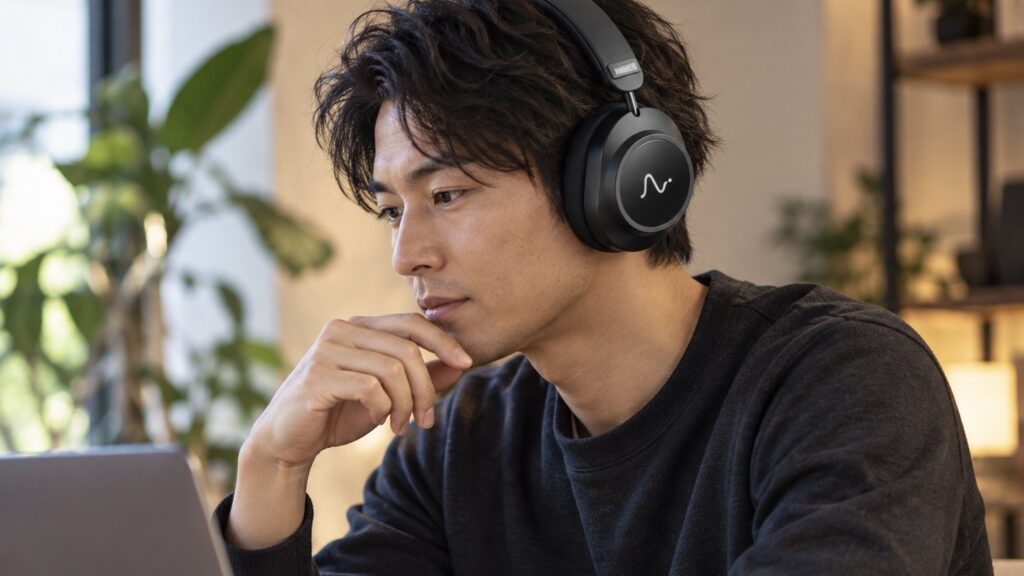
On October 1, 2026, the American neurotechnology company Neurable announced new headphones called “Neurable One.”
They look like ordinary noise-canceling headphones, but built into the ear cushions are 12 EEG sensors .
And among the product’s features, one of the most intriguing is
“Brain Battery.”
That’s the one.
Much like a smartphone’s battery indicator, it estimates from brainwave data “how much mental energy you have left right now.”
Measuring Brainwaves with Headphones
EEG stands for
electroencephalography (brainwave measurement).
It measures the faint electrical signals produced when nerve cells in the brain are active, using electrodes placed on the scalp or elsewhere.
When people picture brainwave measurement at a hospital or research facility, many imagine a large setup with multiple electrodes attached all over the head.
What Neurable is aiming for is building that into the headphones you use every day .
Neurable One has 12 dry EEG sensors built into the fabric of its ear cushions, recording the brain’s electrical activity while you wear the headphones.
You listen to music or work, and your brainwaves are measured at the same time.
In other words, they’re trying to take measurements that used to happen in the lab out into everyday life.
What Does “Brain Battery” Measure?
The Neurable One app calculates several metrics from brainwave data.
One of them is Brain Battery.
The company describes it as a metric that estimates “how much cognitive capacity you have left right now,” based on factors such as
your state of focus
cognitive load
signal patterns associated with fatigue
and more.
As you keep working with focus, your Brain Battery drops, and when the app detects signs of fatigue in your brainwave patterns, it suggests taking a break.
Neurable One also displays metrics such as
Focus
Sleepiness
Stress
Brain Age
Alpha Peak Frequency
for a total of eight brain-related metrics.
It’s essentially the idea of
“a smartwatch for the brain.”
That’s the concept.
Can Headphones Alone Really Measure Focus?
The natural question is,
“Can you really measure brainwaves just from around the ears?”
That’s what many people wonder.
Neurable previously conducted research using an EEG headset called “Enten.”
In that experiment, brainwave data was collected from
132 people
337 sessions
45 types of experiments
in total.
In the study, the researchers created states of focus and states of distraction, and analyzed the changes in brainwaves using their own machine-learning algorithm.
They reported that the algorithm detected the “moments of distraction” intentionally induced during the experiment about 80% of the time (80 ± 4.1%) .
They also report being able to measure well-known EEG responses, such as alpha waves when the eyes are closed and the P300, which appears in response to certain stimuli.
In other words,
“Even EEG taken from around the ears can capture, to some extent, brain activity related to focus.”
That possibility has been shown.
But It Doesn’t Measure “Brain Fatigue” Itself
This point is especially important.
Seeing the name “Brain Battery,” you might feel as if it is
“measuring how much fatigue-causing substance has built up in your brain.”
That’s an easy impression to have.
But that isn’t the case.
EEG measures electrical activity on the surface of the brain.
From that, it uses AI to analyze brainwave patterns associated with
attention
focus
sleepiness
cognitive load
and so on, and converts them into an easy-to-understand metric called “Brain Battery.”
Neurable itself states clearly that EEG
does not read the content of your thoughts, words, images or moods themselves.
What’s more, Neurable One is not a medical device.
It is not intended for diagnosing or treating illness or for measuring fatigue in a medical sense; it is a consumer wellness product.
Also, the focus study of 132 people mentioned above was conducted by Neurable’s own researchers and published on bioRxiv as a preprint.
For that reason, we cannot go so far as to say
“Brain Battery’s accuracy has been medically established.”
That would be overstating it.
In particular, it’s worth noting that there is not yet a substantial body of independent, large-scale research on Neurable One itself, released in 2026, or on Brain Battery.
Are We Entering an Era of Measuring Our “Brain Condition”?
Even so, this technology is fascinating.
Until now, we have judged by feel:
“Somehow I just can’t focus.”
“My head feels tired today.”
That’s how we’ve known.
In the future, though,
“My focus is starting to slip, so I’ll take a break.”
“I focus well in the morning, but my Brain Battery starts dropping around 3 p.m.”
We may be able to look back on our own cognitive patterns through data like this.
Neurable One is designed not only for one-off measurements, but also for building up data over weeks and months so you can see how you change over time.
This is a little like the history of sleep tracking.
Where once we only had a vague sense that “I think I slept well,” many people now use smartwatches to review their sleep time, heart rate and daily rhythms.
In the same way, from now on:
from “My head feels tired” to “I rest while watching changes in my brainwaves.”
That kind of era may slowly be approaching.
That said, there’s no need to chase the data too much.
No matter how advanced devices become,
I can’t focus
I’m sleepy
My head feels heavy
I want to rest
these feelings of your own are important signals, too.
At La HEAD, we carefully treat not only the head but also the neck and shoulders, and we value giving you time to rest away from information in a quiet, fully private room.
Even in an age when technology can tell us “when to rest,”
actually making time to rest your mind and body
may be something that never changes.