
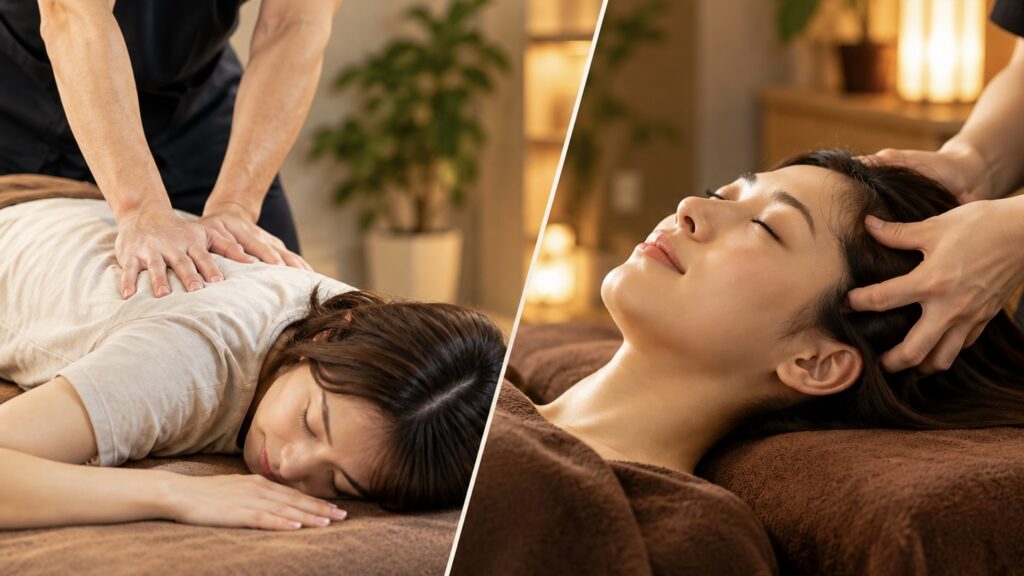
“I go to seitai regularly, but I still can’t shake off my fatigue.” “My neck and shoulders feel better, yet I still can’t sleep at night.”
Does this sound familiar?
Seitai (a Japanese form of manual therapy focused on the body’s alignment) and head massage are both used to ease tension in the body and to relax. However, they differ in the areas they focus on, their approach, and the experience they offer.
Head spas also come in two types, “dry” and “wet,” each with its own methods and characteristics.
In this article, we focus on the differences between seitai and head massage, looking at how they relate to sleep and the autonomic nervous system, and at what makes a dry head spa unique, with reference to medical research.
What Is the Difference Between Seitai and Head Massage?
The main differences between seitai and head massage lie in the purpose of the treatment and the areas it targets.
Seitai generally focuses on the muscles, joints, posture and the way the body moves.
It is often used by people who feel stiff shoulders, tightness in the lower back or restricted movement, and it is characterized by addressing physical discomfort related to the muscles and joints.
Head massage, by contrast, applies pleasant stimulation mainly to the head, aiming to ease tension around the head and guide you into a relaxed state.
The head has a number of muscles that work throughout daily life, including the temporalis, frontalis and occipitalis.
For example, the temporalis near the temples is involved in chewing, and it can come under strain from habits such as clenching the teeth.
Because the head is connected to the neck and shoulders through muscles and other tissues, it is important to pay attention not only to the head but also to the surrounding areas.
That said, seitai sometimes includes work on the head, and head massage sometimes includes care for the neck and shoulders.
It is more accurate to think that seitai is not strictly for the body and head massage strictly for the head; rather, each has its own character depending on the purpose and method of treatment.
So rather than asking which is better, what matters is choosing based on the concerns you have and what you are looking for.
Can’t Sleep or Quiet Your Mind? Which Should You Choose?
If physical pain or restricted movement, such as stiff shoulders or lower back pain, is your main concern, seitai with its focus on muscles and joints is one option.
On the other hand, some people may be dealing not only with physical fatigue but with concerns like these:
• Your body is tired, yet you struggle to fall asleep
• At night, you can’t stop thinking
• Even when you try to rest, the tension won’t go away
• Not just your neck and shoulders, but your whole head feels heavy
• You want to stop thinking and let your mind and body truly rest
Concerns like these may involve not only physical fatigue but also psychological stress and a heightened state of arousal.
Our bodies have a sympathetic nervous system, which tends to become more active when we are busy, and a parasympathetic nervous system, which plays an important role when we rest.
Together they make up the autonomic nervous system, which helps regulate many bodily functions, including heart rate, breathing and digestion.
When stress and anxiety persist, the brain and body can stay in a heightened state of arousal, making it harder to fall asleep.
In sleep medicine, this state is called “hyperarousal,” and it is studied as one of the key mechanisms involved in insomnia.
Head massage, through pleasant stimulation of the head, can be one way to step away from daily tension and racing thoughts and make time to rest slowly.
In particular, for people concerned not only with physical stiffness but also with tension around the head and mental fatigue, head massage may offer a new way to relax.
However, it has not been proven that head massage is more effective than seitai for insomnia or autonomic nervous system problems.
Also, shortness of breath or difficulty breathing may be related not only to stress but to conditions of the lungs or heart. If you have such symptoms, it is important not to rely on relaxation alone, but to see a doctor to find out the cause.
Is Head Massage Good for Sleep and the Nervous System? What Research Shows
Clinical research has in fact looked at the relationship between head massage, sleep and the autonomic nervous system.
A study published in 2016 in The Journal of Alternative and Complementary Medicine examined the effects of a 10-minute head massage in 10 healthy adults.
The study compared receiving a head massage with resting in a chair with eyes closed, measuring heart rate variability (HRV) and other indicators.
Heart rate variability refers to the small changes in the intervals between heartbeats, and it is used as an indicator of how the autonomic nervous system regulates the heart.
The results showed that overall measures of heart rate variability increased significantly after the head massage, suggesting it may influence the heart’s autonomic activity.
However, there were only 10 participants, and clear improvements were not seen in every measure related to the parasympathetic nervous system.
Then in 2026, the international journal Complementary Therapies in Medicine published a randomized controlled trial on the effects of head and face massage on sleep.
The study involved 198 patients receiving intensive care for acute myocardial infarction, who received a 20-minute head and face massage twice a day for two days.
As a result, the group that received the massage showed improvements in both the quantity and quality of sleep compared with the group that did not.
This study used lavender oil or unscented almond oil, so it did not examine dry head spa treatment itself.
And because the participants were hospitalized patients, the same effects cannot be assumed for healthy adults in general or for people with chronic insomnia.
Meanwhile, there is also research on the link between sleep and treatments similar to seitai.
A research review published in Life in 2025 examined 10 randomized controlled trials of manual therapy for the neck, covering a total of 552 people.
Seven of these reported improvement in at least some measures of subjective sleep quality.
In other words, there is research suggesting that both seitai-like manual therapy and head massage may help support sleep.
At present, there is not enough scientific evidence directly comparing which is more effective for sleep or the autonomic nervous system.
Even so, the possibility that pleasant stimulation of the head is linked to relaxation and sleep is an area where further research is anticipated.
Dry Head Spa vs. Wet Head Spa
Another thing worth knowing when choosing a head massage is the difference between “dry” and “wet.”
A dry head spa is a treatment that works directly on the head while it is dry, generally without water, oil or cream.
Because your hair stays dry, there is no need to wash or dry it afterward, which makes it easy to fit in after work or between errands.
And because there is no slip from oil or cream, the therapist can hold the scalp with the fingertips and finely adjust the direction and strength of pressure.
Rather than gliding over the surface of the scalp, the pressure can be held right where it is needed, making it easier to carefully move the muscles and tissues around the head. This is one of the appeals of a dry head spa.
In fact, a study published in 2014 in the Journal of Society of Cosmetic Chemists of Japan compared changes in blood flow produced by several scalp massage techniques.
It reported that on the scalp, “pressing” techniques were more likely to increase blood flow.
However, this study did not directly compare dry and wet treatments, and it did not prove that stronger pressure is more effective.
In treatment, what matters is not simply pressing hard, but applying the right pressure for the condition of the scalp and muscles.
A wet head spa, on the other hand, uses warm water and shampoo, and is performed while washing the scalp and hair.
It may also be combined with treatments, creams or oils as needed, and places importance on cleansing the scalp and conditioning the hair.
Because water and cleansers change how the fingertips glide, the techniques and the feel of the treatment may differ from a dry head spa.
That said, it is entirely possible to apply appropriate pressure in a wet head spa as well.
At present, there is not enough scientific evidence that a dry head spa always reaches deeper or is more effective for sleep or the autonomic nervous system.
To sum up their characteristics: if you mainly want hands-on work around the head and relaxation, a dry head spa is a good choice; if you also want scalp cleansing and hair care, a wet head spa is a good choice.
What Matters Most Is Choosing Care That Fits Your Needs
Seitai, dry head spas and wet head spas each have their own distinct characteristics.
If physical pain or restricted movement concerns you, care that focuses on the condition of the muscles and joints is one option.
On the other hand, if tension around the head or everyday stress is on your mind, you might make time for a head massage to let your mind and body rest slowly.
And if you are concerned about scalp buildup or the condition of your hair, a wet head spa with cleansing may be a good fit.
At La HEAD, a dry head spa salon in Nishi-Shinjuku, we take great care to treat not only the head but also the neck and shoulders.
Drawing on our experience in bodywork and insights gained through our partnership with an osteopathic clinic (seikotsu-in), we tailor each treatment to the individual guest.
Along with the dry head spa technique of holding the scalp and applying careful pressure, we offer time to rest your mind and body slowly in a calm, fully private room.
Beyond simply easing tension in the head, we value giving you time to step away from daily busyness and racing thoughts, and to spend time on yourself.
Of course, head massage is not a substitute for treatment of insomnia, respiratory conditions or other illnesses.
For chronic insomnia, medical diagnosis and appropriate treatment are important. The 2023 European guideline for the diagnosis and treatment of insomnia also recommends cognitive behavioral therapy for insomnia (CBT-I) as the first-line treatment.
Neither seitai nor head massage is simply better than the other.
Paying attention to physical discomfort and letting your head and mind rest slowly are both important for healthy everyday living.
If you go to seitai but still find tension or fatigue in your head, trying a head massage as a different way to relax may be worth considering.
By listening to what you need right now, we hope you can choose the kind of care that suits your mind and body.