
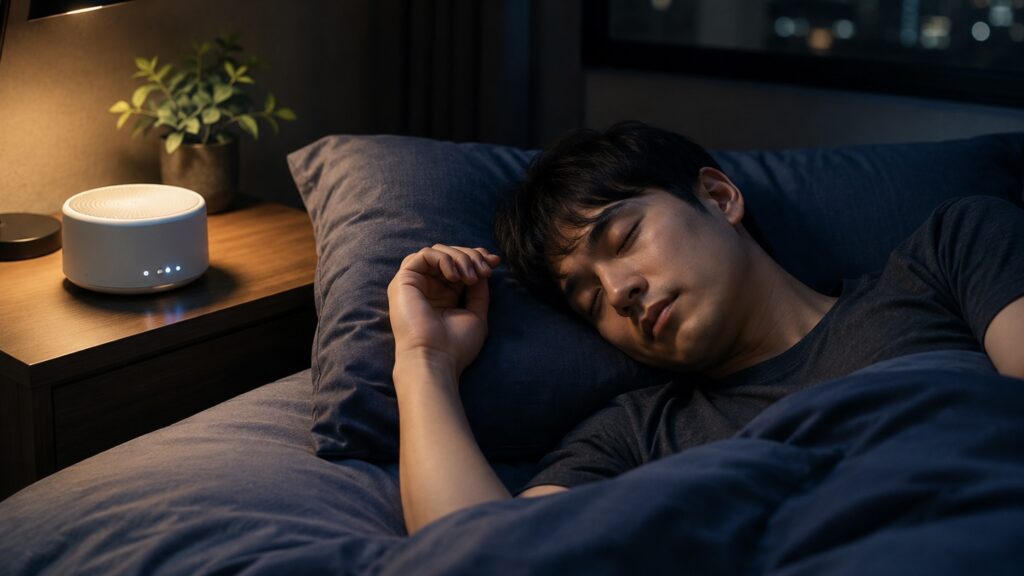
When you sleep, the quieter the better.
Many people probably think so.
At the same time, more and more people these days use YouTube or sleep apps to play sounds such as
rain,
ocean waves,
wind,
white noise
as they fall asleep.
Some may actually feel that it is easier to fall asleep with sound.
So what is really better for sleep: “silence,” or “a steady sound”?
Looking at the research, the key seems to be not simply whether there is sound, but “how to reduce the sounds that disturb sleep”.
What is “white noise” in the first place?
White noise is a steady sound that contains a wide range of frequencies, a kind of
“shhhh”
sound.
It is easy to picture if you think of the static on an old TV.
What is important here is that it has not been established that white noise itself has any special effect that makes people fall asleep.
What sleep research focuses on instead is “sound masking,” which makes irregular noises in your surroundings less noticeable.
For example, in a quiet bedroom,
a car suddenly drives by.
A door closes in the next room.
You hear voices from the hallway.
A car horn sounds outside.
When noises like these occur, even normally faint sounds stand out more the quieter the surroundings are.
The idea is that playing a steady background sound narrows the gap between the background and sudden noises, making them less bothersome.
A study in which white noise shortened the time to fall asleep by about 38%
There are studies that actually used white noise in noisy environments.
In a study of adults living in noisy environments in New York City, sleep was compared under normal conditions and with white noise playing.
With white noise, the time it took to fall asleep (sleep onset latency) became about 38% shorter, the study reported.
There was also an improvement in the time it took to fall back asleep after waking during the night.
In other words, in environments with irregular surrounding noise, using a steady background sound to make that noise less noticeable may make it easier to fall asleep.
In particular:
Along busy roads.
In lively downtown areas.
In apartment buildings.
In bedrooms where outside noise easily gets in.
In places like these, it may be worth a try.
So is a “too quiet” bedroom bad?
This is a point we want to be careful not to misunderstand.
A quiet bedroom is not bad for sleep.
In fact, if your surroundings are quiet and you sleep comfortably, there is no need to go out of your way to play white noise.
The benefits of white noise are expected mainly when irregular sounds around you are disturbing your sleep.
In other words, it is not that
“white noise is better for sleep than silence.”
Rather,
“if there is irregular noise, making it less noticeable with a steady sound may help”
is the more accurate way to think about it.
Research results are still mixed
There are also some points to keep in mind about white noise.
In a systematic review of research on environmental sound and sleep, some studies found that continuous sounds such as white noise improved sleep, while others found no clear effect.
From study to study, things such as
the type of sound,
the volume,
how long it is played,
the participants,
the noise environment,
and how sleep is measured
all differ, which helps explain the mixed results.
So at this point, we cannot go so far as to say that “playing white noise will improve anyone’s sleep quality.”
For some people, the white noise itself can be distracting and keep them awake.
Whether you personally find it comfortable is also important.
What about rain or ocean sounds?
If you don’t like the “shhhh” of white noise, you may prefer sounds such as rain or waves.
What matters is not choosing white noise specifically.
Relatively steady environmental sounds such as rain can also be one option for improving your sleep environment, as long as you find them pleasant and they don’t include sudden loud sounds.
However, there is no need to turn the volume up high.
Also, rather than sleeping with earphones in, if possible playing it at a low volume through a speaker may be easier to adopt.
You can also use a timer so it plays only while you are falling asleep.
What matters more than “quiet” is an environment where you can sleep at ease
When thinking about your sleep environment,
“It has to be completely silent”
“It’s better to play white noise”
you don’t need to look for one right answer like these.
If you already sleep well in a quiet environment, there is no need to change anything.
On the other hand, if cars outside or everyday noises keep you awake, try white noise or a steady environmental sound.
What matters is not “getting rid of sound,” but “reducing the sounds that disturb your sleep.”
At La HEAD, too, in a calm, fully private room, we pay attention to the environment, including what you see and hear, as we carefully care for not only the head but also the neck, shoulders and arms.
During the day, we spend our time surrounded by all kinds of stimulation: computers, smartphones, conversations, the sounds of the city.
That is exactly why, at night, create a “sound environment” where you can sleep at ease.
If everyday noises around you keep you from sleeping, why not try white noise or rain sounds at a low volume and see whether they work for you?