
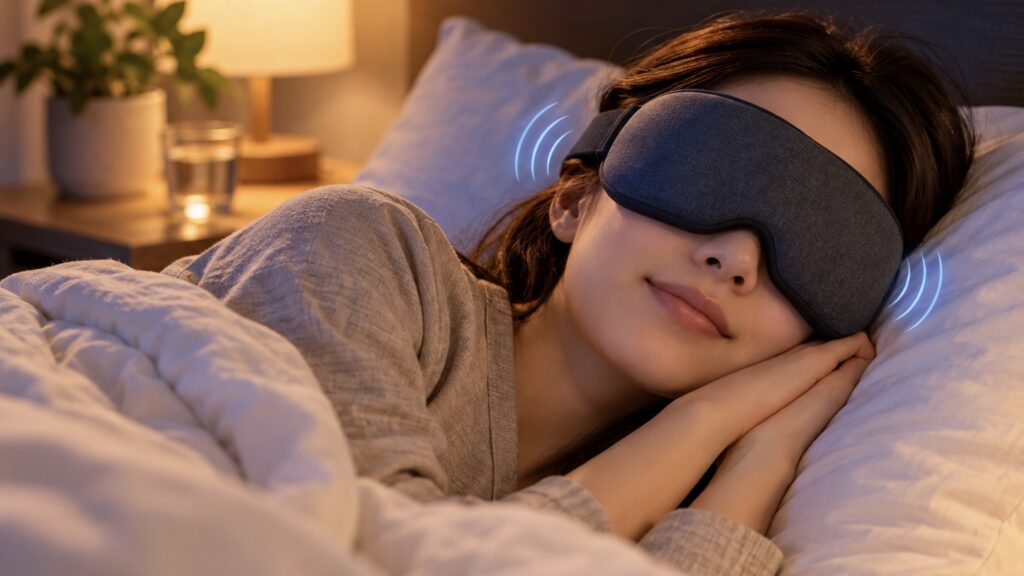
When we think of an eye mask, we usually picture something that blocks out light to create a better environment for sleep.
Recently, however, eye masks have appeared that do more than block light: vibrating eye masks that apply gentle vibration around the eyes have also come onto the market.
In 2026, a study published in the sleep medicine journal Sleep and Biological Rhythms examined what changes these vibrating eye masks actually bring to sleep.
A Six-Week At-Home Study of 91 People
The study was carried out by a research team at SleepScore Labs, a sleep research organization in the United States.
The participants were 91 adults with mild sleep concerns, such as trouble falling asleep or waking during the night. Their average age was 45, and about 69% were women.
Over six weeks at home, the participants went through three conditions:
• A period without an eye mask: 14 days
• A period using a vibrating eye mask: 14 days
• A period using a non-vibrating eye mask: 14 days
Each participant experienced all three.
The mask used was Therabody’s SleepMask. During the vibration period, at bedtime the mask delivered about 15 minutes of vibration that gradually grew weaker.
Sleep was measured not only by how participants felt, but also objectively with SleepScore Max, a contactless device validated against polysomnography.
About 12 More Minutes of Sleep and About 3 More Minutes of Deep Sleep
Compared with the non-vibrating eye mask, nights with the vibrating eye mask showed the following changes:
• Time in bed: about 11.1 minutes longer
• Actual sleep time: about 11.9 minutes longer
• Deep sleep: about 3.1 minutes longer
• Proportion of light sleep: about 1.8% lower
These were the changes observed.
You may be thinking, “Only 12 minutes?”
It is true that sleep time did not increase dramatically.
Still, what makes the study interesting is that it was a crossover trial in which the same people experienced both the vibrating and non-vibrating conditions, comparing sleep data from about 2,851 nights.
Why Would Vibration Change Sleep?
There is no clear answer to this yet.
What this study shows is only that a small improvement in sleep measures was seen when people used an eye mask with vibration.
That said, the link between vibration and sleep has been studied for some time.
In a 2021 experiment with 12 participants by a research team including Seoul National University, gentle vibration timed to the heartbeat led to changes in brain waves and the autonomic nervous system during deep sleep, and an improvement in memory retention was also observed.
Of course, the vibration method used in that study is different from the eye mask in this one.
For that reason, we cannot simply conclude that vibration boosts the parasympathetic nervous system and leads to deeper sleep.
Several factors may be involved, such as a pleasant, steady stimulus making it easier to relax, and fewer stimuli before bed.
Not Just Vibration: Blocking Light Matters Too
The SleepMask used in this study is designed not only to vibrate but also to block light thoroughly.
However, because the study compared it with a non-vibrating eye mask, the difference it found cannot be explained simply by the room being darker.
At the same time, reducing light in your sleep environment is important in its own right.
Therabody’s SleepMask, a consumer product with complete light blocking and three vibration patterns, is also sold in Japan. Please note that it is not a medical device.
To improve sleep, it is best not to rely on devices like this alone.
Dimming the lights, spending less time on your smartphone, adjusting the room temperature: combining devices with this kind of pre-sleep routine is what really matters.
Make Time to Switch Off Before Bed
What I personally find interesting about this study is not just the vibration itself, but the fact that it creates 15 minutes before bed to rest quietly in the dark.
Between work, smartphones, and social media, we take in a great deal of information right up until bedtime.
Rather than switching straight from activity mode to sleep, try making time to:
Dim the lights
Put down your smartphone
Close your eyes
Let your body rest quietly
Creating time like this is also an important part of preparing a good sleep environment.
Vibrating eye masks are a new kind of sleep device, and research on them has only just begun.
These results alone are not enough to claim that using one will improve sleep quality, but as one new option for how to create a relaxing time before sleep, they are worth watching as research continues.
At La HEAD, we also value giving your head, neck, and shoulders, tense from the day, time to rest slowly, and simply making time to do nothing.
When you look at your daily sleep, why not pay attention not only to how many hours you sleep, but also to how you spend the time before bed?