
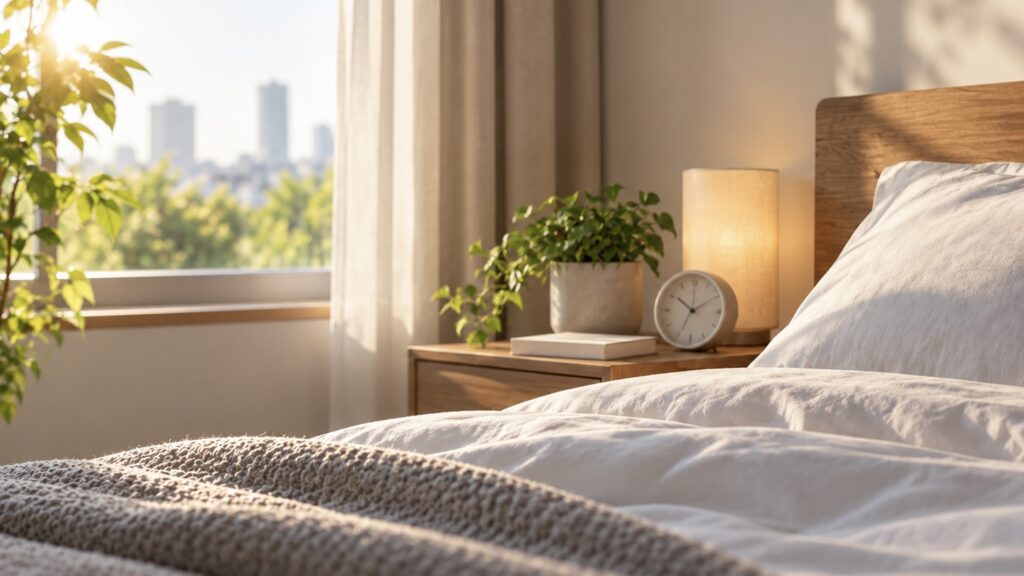
“What can I do to sleep better?”
When we struggle with sleep, we tend to think about adding something: buying expensive bedding, trying foods said to be good for sleep, or bringing in the latest sleep gadgets.
But when Professor Masashi Yanagisawa of the International Institute for Integrative Sleep Medicine (WPI-IIIS) at the University of Tsukuba, winner of the 2026 Albert Lasker Basic Medical Research Award, talks about sleep, one of his key ideas is that
“sleep works on a point-deduction system.”
It’s a simple but powerful way of looking at sleep.
Instead of searching for a one-size-fits-all method that guarantees a perfect score, the idea is to look at light, temperature, alcohol, daily rhythms and more, and remove the things that disrupt your sleep, one by one.
So what exactly should you look at?
In this post, we introduce five of the ideas and sleep habits Professor Yanagisawa shares that are especially easy to bring into everyday life.
1. Get Enough Sleep Before Worrying About Sleep Quality
“If I sleep deeply, a short night is fine.”
You may think so too.
But no matter how much you work on improving sleep quality, it can’t fully make up for not getting enough sleep in the first place.
One problem Professor Yanagisawa repeatedly points to is how little people in Japan sleep.
Because the amount of sleep people need varies, it isn’t as simple as “everyone should sleep X hours.”
One helpful clue is how you sleep on your days off.
You sleep only six hours on weekdays, yet on your days off you end up sleeping eight or nine hours without an alarm.
If that sounds familiar, you may be making up on your days off for sleep you missed during the week.
Also, when sleep deprivation continues, people get used to it, and even if you feel “I’m fine on little sleep,” you may not actually be getting enough.
That’s why, when improving your sleep, the first question to ask is
not “How can I sleep more deeply?” but “Am I sleeping long enough in the first place?”
That is where to begin.
Before chasing sleep “quality,” first secure the “quantity” you need.
This is the foundation.
2. Bright Mornings, Dark Nights: Use Light to Set Your Body Clock
Closely tied to sleep is the body clock built into each of us.
On a roughly 24-hour cycle, the body shifts many of its functions toward activity in the morning and toward rest at night.
And a very important cue for syncing this body clock with the outside world is light.
Getting bright light in the morning tells the brain that it is morning, and the body clock is adjusted.
On the other hand, if you spend late evenings in bright surroundings, your body keeps receiving signals that it is still daytime.
Here, Professor Yanagisawa points out that we should not make smartphones the only villain.
It’s often said that blue light from your phone is bad before bed, but phones aren’t the only problem.
Bright white ceiling lights and the like—the light you are exposed to at night in general—also deserve attention.
That’s why it helps to
open the curtains when you wake up,
spend the daytime in bright surroundings as much as possible,
dim the lights a little in the evening,
and keep the bedroom as dark as possible.
This contrast of bright mornings and dark nights is what matters.
Sleep isn’t decided just in the moments before bed.
What kind of light you got in the morning, and what kind of light you spent the evening in.
How you use light throughout the day carries through to your sleep at night.
3. Keep the Bedroom Dark, Quiet and at the Right Temperature
You’re unconscious while you sleep, so a little heat or light shouldn’t matter.
It’s easy to think so, but even during sleep, the brain and body are affected by their surroundings.
What Professor Yanagisawa emphasizes for the sleep environment are the basics:
“dark, quiet, and a comfortable temperature until morning.”
These are the essential conditions.
The one to look at especially closely is room temperature.
In summer,
“Sleeping with the air conditioner on seems bad for my body,”
many people think, and set a timer to switch it off.
But once the air conditioner turns off and the bedroom heats up, the heat can wake you up during the night or make your sleep unsettled.
During hot weather, Professor Yanagisawa recommends that rather than forcing yourself to turn off the air conditioner, you keep the room at a temperature you find comfortable all the way until morning.
The point isn’t to think that a certain temperature is right for everyone.
Comfortable temperatures vary with bedding, humidity and your own constitution, so
create an environment where you can sleep without feeling hot or cold until morning.
The same goes for light and sound.
Streetlights shining through gaps in the curtains, sleeping with the TV on, noise from outside—even if you feel used to them, they are worth reconsidering as part of your sleep environment.
Before buying a new sleep gadget,
ask yourself, “Is my bedroom itself a place that makes sleep easy?”
Check that first.
This, too, is exactly the point-deduction approach to sleep.
4. A Nightcap May Help You Fall Asleep, but It Hurts Your Sleep
“Alcohol makes me sleepy, so isn’t it good for sleep?”
This is a very common misconception.
It’s true that alcohol has a sedative effect, and drinking can help you fall asleep faster.
So you may well feel that
“I slept well on the nights I had a drink.”
That is how it can seem.
But the problem comes after you fall asleep.
As your body metabolizes alcohol over time, your sleep tends to become lighter and you are more likely to wake up during the night.
And if you drink a lot, its diuretic effect may send you to the bathroom in the middle of the night.
In other words,
falling asleep quickly is not the same as getting good sleep.
Professor Yanagisawa in particular does not recommend a “nightcap”—using alcohol to help you sleep.
Of course, this doesn’t mean you can never have a single drink.
What matters is not making a habit of
“I can’t sleep, so I’ll have a drink.”
That is the pattern to avoid.
You may think you’re drinking to fall asleep more easily, but in the end it disrupts your sleep at night.
It is exactly the kind of habit that can cost your sleep points.
5. When You Can’t Sleep, Stop Trying So Hard in Bed
“I have to get up early tomorrow.”
“It’s already midnight and I still can’t sleep.”
“I only have six hours left to sleep…”
Have you ever noticed that once thoughts like these start, you only become more wide awake?
Sleep is a little unusual:
trying harder doesn’t necessarily make you more successful.
If anything, telling yourself “I absolutely have to sleep” can raise tension and alertness and push sleep further away.
That’s why Professor Yanagisawa suggests not staying stuck in bed when you can’t sleep.
As a rule of thumb, if you still can’t sleep after about 10 to 20 minutes, get out of bed for a while.
Then, instead of turning on bright lights, spend the time quietly in dim surroundings, and go back to bed once you naturally start to feel sleepy.
Why go to the trouble of getting out of bed?
One reason is conditioning.
If every night in bed you
can’t sleep,
check the clock,
feel anxious,
look at your phone,
and try hard to sleep again,
then over time, your bed may stop being a place for sleeping and instead become a place where you lie awake feeling anxious.
Instead, the idea is that you
go to bed when you feel sleepy.
Little by little, you build that connection.
Rather than straining to fall asleep, create an environment where sleepiness comes easily, and leave the rest to your body.
This connects to an approach called “stimulus control,” which is also used in cognitive behavioral therapy for insomnia.
Good Sleep Is Less About What You Add Than What You Remove
Looking back at these five tips, you may notice something surprising.
There are no special sleep gadgets and no expensive bedding.
Get the sleep you need.
Keep mornings bright and nights dark.
Adjust the light, sound and temperature in your bedroom.
Skip the nightcap.
Don’t struggle in bed when you can’t sleep.
All of them are very simple.
But when you apply Professor Yanagisawa’s idea that “sleep works on a point-deduction system,” their meaning becomes clear.
Instead of searching for a magic method that pushes your sleep above a perfect score,
think about how many points are being taken away from your sleep right now.
If you’re not sleeping long enough, start by fixing that.
If your nights are too bright, rethink your lighting.
If the heat wakes you up, adjust the room temperature.
If you rely on a nightcap, try giving it up.
If you feel anxious about not sleeping, try leaving your bed for a while.
There’s no need to change everything at once.
“Try removing just one thing that is getting in the way of your sleep.”
The message from one of the world’s leading sleep researchers is surprisingly simple.
Here at La HEAD, we have shared many studies on sleep and rest from Japan and around the world.
When life is busy, it’s easy to feel that you have to try harder to be healthy.
But when it comes to sleep, rather than working hard to add something, gradually let go of the things that get in the way of sleep.
Tonight, why not start by thinking about one thing you could remove from your sleep?