
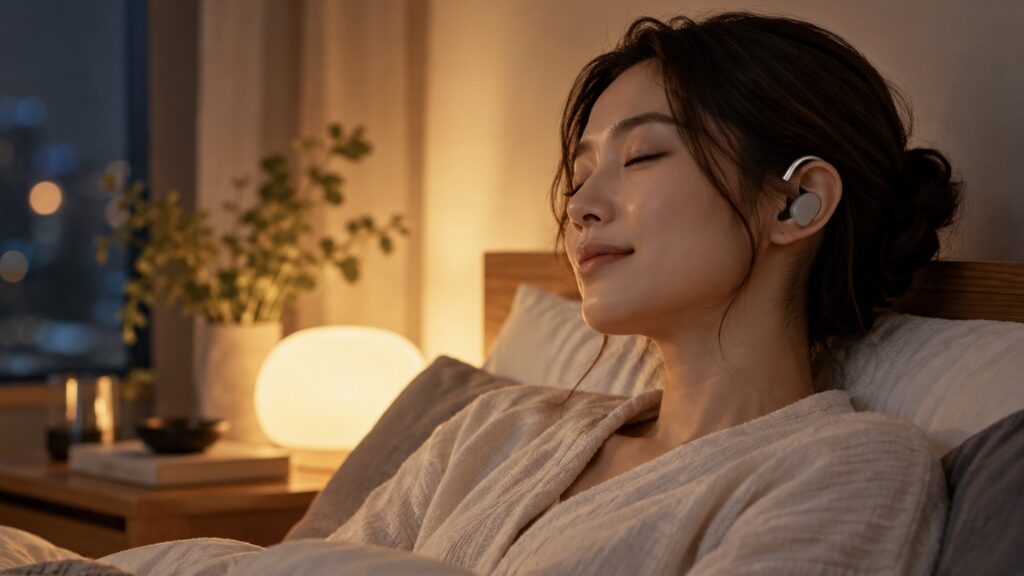
Lately, one type of product appearing more and more in wellness markets overseas is the device worn on the ear or neck that delivers a gentle electrical current.
Among these, one approach is drawing particular attention:
VNS (Vagus Nerve Stimulation)
That is the technology we look at here.
Wearable devices are now sold with claims that they support stress relief, relaxation and sleep.
Meanwhile, in medical and sleep research, studies are also moving forward on tVNS (transcutaneous vagus nerve stimulation), which stimulates the vagus nerve from outside the body.
So the question is this:
“Does stimulating the vagus nerve really make it easier to fall asleep?”
Let’s look at what the latest research published in 2026 tells us.
What Is the Vagus Nerve?
The vagus nerve is a cranial nerve that runs from the brainstem down through the neck and branches widely to the heart, lungs, digestive tract and other organs.
It plays a major role in the parasympathetic side of the autonomic nervous system, and is involved in
Heart rate
Breathing
Digestion
Signals sent from the internal organs to the brain
along with many other bodily functions.
That said, it is worth adding a caution.
“The vagus nerve is the relaxation nerve”
is an oversimplification, and not quite accurate.
The vagus nerve contains not only fibers that carry signals from the brain to the body, but also many fibers that report the state of the body back to the brain.
VNS is a method of stimulating this nerve electrically to act on the neural networks of the brain and body.
Conventional VNS includes a method in which a stimulator is surgically implanted in the body.
In recent years, however, attention has turned to a method that delivers stimulation through the skin:
tVNS (transcutaneous Vagus Nerve Stimulation)
This approach requires no surgery.
A method that stimulates part of the ear in particular is known as
taVNS (transcutaneous auricular Vagus Nerve Stimulation)
and it is the focus of much of the research below.
2026: A New Review of 13 RCTs
The October 2026 issue of the medical journal Sleep Medicine Reviews published a systematic review and meta-analysis by a research team from Incheon National University and Korea University.
The team brought together 13 randomized controlled trials (RCTs) on tVNS and sleep.
Compared with control groups, the groups that received tVNS showed changes in the direction of
Better sleep quality
Milder insomnia symptoms
according to the pooled results.
Even more interesting was the difference depending on where the stimulation was applied.
The hollow near the center of the ear is called the
concha
and studies that stimulated this area tended to show a relatively larger effect on sleep quality.
This may be related to the fact that a branch of the vagus nerve, the auricular branch, runs through part of the ear.
However, this study alone does not allow us to conclude that stimulating the concha will help you sleep.
That is because the studies differed in the strength, duration and frequency of stimulation, as well as in who took part.
Changes in How Long It Takes to Fall Asleep?
In July 2026, a research team in China also published a separate meta-analysis of 14 RCTs.
Looking at taVNS for people with sleep disorders, this study reported the following:
Sleep quality: improved
Time to fall asleep: shortened
Anxiety and depression scores: improved
These were the main findings.
For the time to fall asleep, the effect size was SMD −0.44.
On safety, most side effects in the included trials were mild and either resolved on their own or improved with treatment.
Even so, the researchers themselves noted that
results varied widely between studies, and larger, higher-quality RCTs are needed
, as they stated in their conclusions.
In other words, for now it is
“promising, but not yet an established sleep treatment”
and that is where it currently stands.
Studied in Patients with Chronic Insomnia, Too
Beyond meta-analyses, there are also clinical trials in patients who actually have chronic insomnia.
In a randomized clinical trial conducted in Beijing, China, and published in JAMA Network Open in 2024, 72 patients with chronic insomnia were divided into two groups:
A group receiving real taVNS
and
A group receiving sham stimulation
for comparison.
The stimulation schedule was
30 minutes per session
Twice a day
Five days a week
For eight weeks
over the course of the trial.
After eight weeks, scores on the PSQI, a measure of sleep quality, improved by
an average of 8.2 points in the real taVNS group
and by an average of 3.9 points in the sham group
from where they started.
The difference between the groups was 4.2 points, exceeding what the study had defined as a clinically meaningful difference.
The effect also lasted through week 20, the end of the study period.
On the other hand, this study was limited in scale, with one site and 72 people.
The researchers also say it needs to be confirmed in larger trials across multiple sites.
In 2025, Korea University also reported a double-blind trial in 40 people with chronic insomnia, comparing 30 minutes a day of taVNS for six weeks with sham stimulation.
It seems fair to say that the quality of research in this field is steadily improving.
Do VNS Wearables Sold Overseas Have the Same Effect?
This is where particular care is needed.
Consumer VNS wearables worn on the neck or ear are now on sale overseas.
Pulsetto, for example, sells vagus nerve stimulation devices such as the FIT X, which is worn around the neck.
Seeing products like these, you might think,
“If research shows taVNS works, won’t a store-bought VNS device help me sleep in the same way?”
It is a natural question to ask.
However, the two are not the same thing.
In clinical studies, researchers carefully set
The stimulation site
Frequency
Pulse width
Stimulation intensity
Session length
Length of use
along with other details.
Consumer wearables, on the other hand, differ in their stimulation methods and design from device to device.
For that reason, we cannot assume that
“taVNS research results = the effect of every VNS wearable on the market”
holds true.
The 2026 meta-analysis is not a study that guarantees the effect of any particular consumer wearable either.
In addition, a 2025 meta-analysis on insomnia combined six studies with 336 people and found improvements in sleep measures, but rated the certainty of the evidence as low to very low.
Even so, the idea of
“improving sleep by working on the nerves themselves”
beginning to be studied is a fascinating shift.
Until now, sleep advice has mostly meant changes to our lifestyle and surroundings:
Changing your bedding.
Darkening your room.
Taking a bath.
Exercising.
Cutting back on your smartphone.
These approaches have been at the center of it all.
In recent years, research has added a new option:
“neuromodulation,” which acts directly on nerve activity
is now part of the conversation.
For now, it is too early to think of a VNS wearable as a machine that puts you to sleep once you put it on.
Still, with meta-analyses of multiple RCTs appearing in 2026, this is one field worth watching as we think about how sleep relates to the autonomic nervous system and the vagus nerve.
At La HEAD, when we think about sleep and relaxation, we care not only about resting because you are tired, but about how the body and mind make the transition into rest.
Rather than relying only on new technology,
Dimming the lights
Stepping away from your smartphone
Letting your body relax
Making time to rest slowly
These basic habits matter too, and we look forward to following how sleep technology develops from here.