
“How many hours before bed should I finish dinner to sleep well?”
“Should I cut back on carbs at night?”
When we think about sleep, we tend to focus on bedding, bathing or the bedroom environment, but in fact the timing and content of dinner are also important factors for sleep.
Before searching for a special “sleep-friendly food,” the first thing to consider is when, how much and what you eat.
In this article, we draw on what research has found about evening meals and sleep to share some points worth keeping in mind at dinner each day.
1. How Many Hours Before Bed Should You Eat Dinner?
The first question many people have is how much time to leave between dinner and bedtime.
Eating a large meal late at night and heading straight to bed is a habit best avoided if you want to sleep well.
Once you eat, digestion and absorption begin, and your body’s state, including metabolism and body temperature, changes. Some studies have also reported a link between late meals close to bedtime and how people sleep.
On the other hand, current research has not established a clear cutoff, such as “eat at least a certain number of hours before bed and your sleep quality will improve.”
As a practical guide that is easy to follow in daily life, we suggest this:
Finish dinner at least two to three hours before going to bed.
Leaving about this much time is a good place to start.
For example, if you go to sleep at 11 p.m., aim to finish dinner by around 8 to 9 p.m.
2. What You Eat at Night Matters, Too
So what should you eat for dinner?
A meta-analysis published in Sleep Medicine Reviews in 2025 pooled data from 62 studies and about 328,000 people to examine the relationship between the Mediterranean diet and sleep.
The Mediterranean diet is an eating pattern rich in vegetables, fruit, fish, legumes, whole grains and nuts.
The analysis reported that following this kind of diet more closely was associated with better sleep.
However, most of the studies were observational.
So rather than thinking “eating this food will help me sleep,” it is more accurate to see it this way: the overall balance of your everyday diet may be related to your sleep is the more fitting way to look at it.
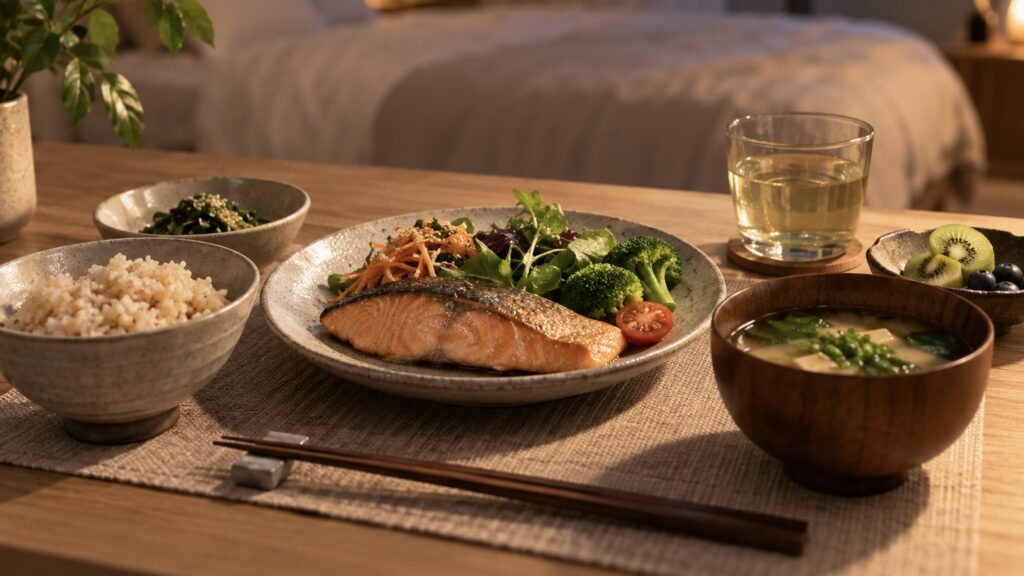
For a typical Japanese dinner,
a simple combination of protein such as fish, meat or soy products, plus vegetables and a moderate serving of a staple such as rice
is all you need.
A standard Japanese meal of grilled fish, rice, miso soup and a vegetable side dish, for example, is an easy way to put together an evening meal.
3. Watch How Much You Eat Before Bed
Beyond what you eat, the amount you eat at dinner matters too.
What you especially want to avoid is a large meal right before bed.
Many people may find themselves coming home late, eating a lot at once because they are hungry, and then going straight to sleep.
Heavy, high-fat meals such as fried foods or fatty cuts of meat are also worth keeping in moderation late in the evening.
On days when dinner simply has to be late, instead of eating your usual amount at a later time, making it a little lighter is one option to consider.
For better sleep, think not only about what you eat but also about not going to bed while your stomach is still working hard, as this can make a real difference.
4. Should You Skip Carbohydrates at Night?
Some people may believe it is better not to eat carbohydrates at night.
However, for the sake of sleep, there is no need to cut carbohydrates out of dinner completely.
Carbohydrates such as rice are an energy source your body needs.
What matters is not focusing on a single nutrient as in “carbs are bad,” but thinking about the balance of the meal as a whole.
Keep rice to a moderate portion, and combine it with protein such as fish, meat or soy products, along with vegetables.
For good sleep, too, rather than extreme dietary restrictions, a well-balanced dinner you can keep up without strain is the more realistic foundation.
5. For Better Sleep, Take Another Look at When You Eat Dinner
You do not need to eat special foods every day to sleep well.
The first thing to keep in mind is this:
If possible, finish dinner two to three hours before bed.
Then combine protein such as fish, meat or soy products with vegetables and a moderate serving of a staple, and avoid overeating or heavy meals right before bed.
Of course, diet alone does not determine the quality of your sleep.
Many factors are involved, including how long you sleep, light, exercise, bathing, caffeine, alcohol and your bedroom environment.
Even so, dinner, something we do almost every day, is one of the easier daily habits to rethink.
If you usually pay attention only to what time you go to bed, why not start tonight by also asking yourself,
“What time did I finish my last meal?”
It may be worth paying attention to that as well.
At La HEAD, we will continue to share research on sleep, the brain and rest in ways that are easy to bring into your everyday life.