
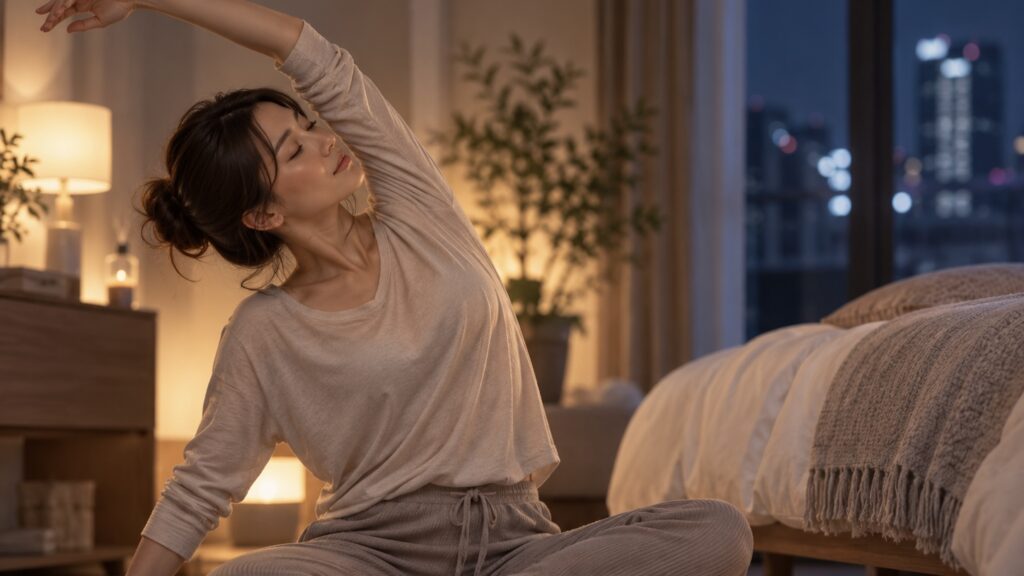
“I feel like my body has gotten stiffer than it used to be.”
“After a full day at my desk, my neck, shoulders, and back still feel tight at night.”
Is there any link between this kind of physical state and sleep?
Many people have a vague image that “flexible people probably sleep better,” but the science is a little different.
According to current research, there is not enough evidence to directly link “the stiffer your body, the worse your sleep quality.”
On the other hand, when it comes to the relationship between stretching, which slowly lengthens the body, and sleep, some interesting studies have been reported.
“High Flexibility = Good Sleep” Is Not Always True
First, it is important to note that “flexibility” and “stretching” are not the same thing, and the two should be distinguished.
Flexibility is a physical characteristic, such as how far your joints can move and how much your muscles can stretch.
Stretching, on the other hand, is a type of exercise that is also done to maintain or improve that flexibility.
For that reason, a cause-and-effect relationship like the one below has not been proven:
stiff body → lower sleep quality
There is no solid evidence for this chain of events.
However, there are studies that looked at how sleep changes when people make stretching a habit.
What Did a Review of 16 Studies Find About Sleep?
In 2024, a scoping review of studies on stretching and sleep was published in the European Journal of Applied Physiology.
It covered 16 studies in which stretching was done by people with sleep problems.
Overall, there was a trend toward better sleep, but only in 5 of the 16 studies was a statistically clear improvement confirmed.
In other words, current research does not go as far as to say:
“If you stretch before bed, anyone’s sleep quality will improve.”
That cannot be said yet.
On the other hand, since some studies did confirm positive changes in sleep, stretching may be one way to support better sleep.
Changes in Sleep After 4 Months of Stretching
Even more interesting is a study of 28 adults suffering from chronic insomnia.
Participants were divided into groups, including one that did stretching, and changes over a period of 4 months were examined.
As a result, the stretching group showed improvements in
the severity of insomnia, the time it took to fall asleep, time spent awake during the night, sleep efficiency, and subjective sleep quality
, among other things.
In particular, the time it took to fall asleep became about 5 minutes shorter, and sleep efficiency improved by about 5 points.
However, this study had a small number of participants, and for some items, no clear difference was found in objective sleep measures using polysomnography.
So, while the results are very interesting, this alone does not prove that stretching improves sleep.
Why Might Stretching Be Linked to Sleep?
This raises the question:
“Why would stretching your body lead to better sleep?”
That is what we want to know.
Possible reasons include stretching easing muscle tension, and slow movements helping both body and mind relax.
Also, the few minutes you spend stretching become time to step away from work and your smartphone and turn your attention to your own body.
However, it has not been proven that “sleep improved because flexibility increased”, and this is an important point to keep in mind.
At this point,
using stretching to release tension in your body and spend the time before sleep calmly, rather than making your body more flexible itself,
may be what really matters.
What Matters Is Not “Flexibility” but Relaxing Your Body Before Sleep
You do not need to become flexible enough to do the splits for the sake of sleep.
There is also no need to think, “My body is stiff, so I can’t sleep.”
Rather, an easy thing to try is slowly stretching your neck, shoulders, back, legs, and so on, only to the point where it feels good, even for just a few minutes before bed.
Using a computer and smartphone all day, keeping both your mind and body active, and then going straight to bed.
If that sounds like your daily life, it may be a good idea to create a little “time to do nothing” or “time to relax your body” before sleep.
What current research tells us is this:
We cannot yet say that “the more flexible you are, the better you sleep.”
However, making stretching a habit may be one way to support better sleep.
That is what the findings suggest.
What matters for sleep is not competing over flexibility numbers.
At the end of the day, gradually switch your tense body into a state of rest.
Why not start by making time for that?