
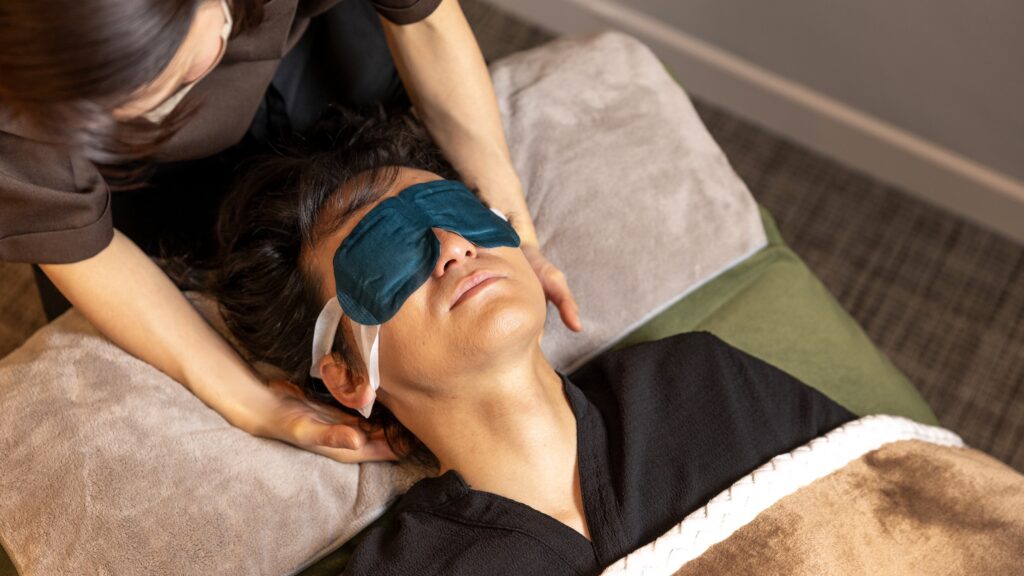
During a massage, have you ever thought,
“My head is getting pleasantly hazy,”
“I must have dozed off,” or
“Afterward, even my mind feels clearer”?
Many of us have been there.
When people think of massage, many picture something that loosens tight muscles.
But recent research shows that when a treatment feels good, a variety of responses are taking place not only in the body but in the brain as well.
In 2026, a new review was also published that brings together previous research on massage and brain activity.
Analyzing “the Brain During Massage” Across 47 Studies
A review published in 2026 in the Journal of Clinical Medicine analyzed 47 studies conducted between 1990 and 2025.
The studies used methods such as:
EEG (electroencephalography)
→ Measures the brain’s electrical activity
fMRI (functional MRI)
→ Shows which areas of the brain are active
fNIRS (functional near-infrared spectroscopy)
→ Captures changes in blood flow and oxygenation in the brain
These were the main tools used.
In other words, researchers are not relying only on the subjective sense that “a massage makes me feel relaxed.” They are also studying what changes can actually be observed in the brain at that moment.
Alpha Waves: A Common Sign of Relaxation
One finding reported by several EEG studies in the review is an increase in alpha waves.
Alpha waves are known as brain waves that tend to appear not so much during sleep, but when we are awake yet relatively relaxed.
Some studies also reported decreases in beta and gamma waves.
These results suggest that the physical stimulation of massage may affect more than just the muscles; it may also be accompanied by changes in the brain’s state of activity.
That said, more alpha waves do not automatically mean a person is relaxed. Brain waves change with the situation and the measurement conditions, so the results need to be interpreted with care.
“Feeling Good” Happens in the Brain
So why does being touched lead to a sense of comfort?
When a massage stimulates the skin and muscles, that information travels through the nerves to the brain.
The brain does not simply register,
“Someone is touching my head,” or
“Someone is pressing on my shoulders.”
It does much more than that.
Studies using fMRI have observed changes in areas such as the insula and the anterior cingulate cortex, which are involved in processing internal bodily sensations, emotions and pain.
In other words, the pleasant feeling of a massage likely involves both the stimulation of the skin and muscles and the brain’s work in receiving and processing it.
It is also fascinating that the same act of being touched can feel either pleasant or unpleasant, depending on the stimulus.
Does Stronger Always Feel Better?
“If I’m getting a massage anyway, stronger pressure must work better.”
Some people may think this way.
But when it comes to touch, stronger is not always better.
The review also points out that neurophysiological responses may differ depending on the strength of the pressure, and some studies reported relaxation-related responses with moderate pressure.
Comfort depends not only on pressure but also on many other factors, such as
the way you are touched, the rhythm, the speed, the setting of the treatment, and how you personally feel.
Pressing so hard that it hurts does not necessarily mean you will relax more.
A Time to Turn Your Attention to Sensation, Not Just Your Body
Computers at work.
Smartphones on the go.
Social media on breaks.
Throughout the day, we are constantly taking in new information, thinking and making decisions.
In a life like this, a massage can be a time to step away from your phone, close your eyes and shift your attention from “seeing, reading and thinking” to “feeling with your body”.
At La HEAD, in a calm, fully private room, we treat the head, neck, shoulders and arms as one connected whole, with careful attention to comfortable pressure and rhythm.
The comfort of a massage is not just about having your muscles pressed.
Your skin receives the stimulation, it travels through the nerves to your brain, and you experience that sensation as “feeling good.”
Precisely because we spend our days processing so much information, why not sometimes close your eyes and make time to step back from thinking and simply enjoy feeling good?
Please note that the 2026 review covers a wide range of massage methods, participants and study conditions, and the results vary between studies. For this reason, it cannot be said with certainty that a particular massage will produce specific changes in the brain.
Still, thinking about the comfort of massage from the perspective of the brain, not just the body, may make your usual treatment feel a little different.
We look forward to welcoming you.