
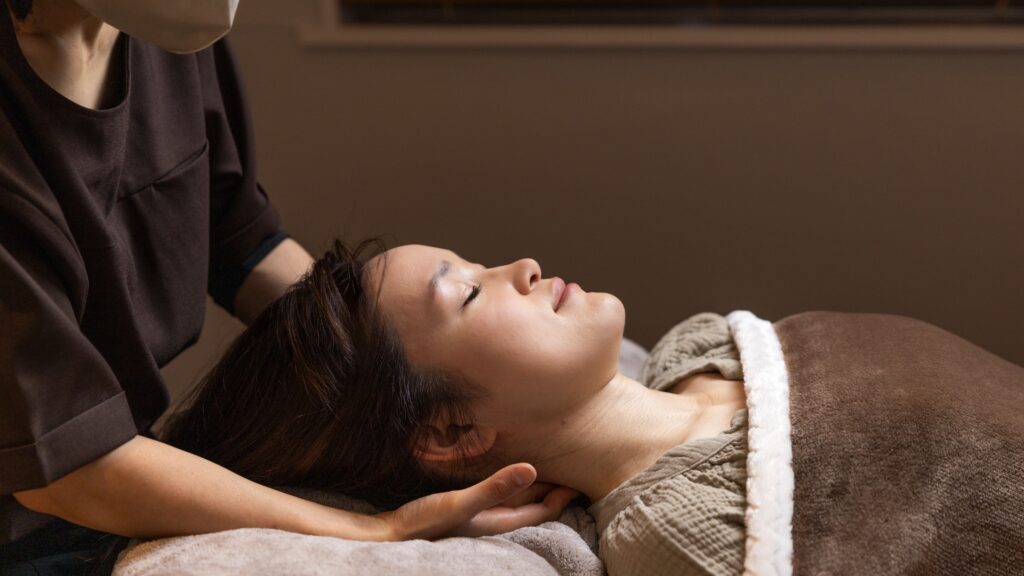
“On days when I’ve had a head massage, I find it easier to fall asleep.”
Some of you may have experienced that feeling.
So does easing tension in the head really change how we sleep?
In 2026, the medical journal Complementary Therapies in Medicine published a randomized controlled trial that directly examined head and face massage and sleep.
The results suggest there may be an interesting link between head massage and sleep. At this point, however, we cannot go so far as to say that anyone who has a head massage will sleep better.
Here, focusing on the latest research, we explain what is currently known.
A 2026 Study of “Head and Face Massage” in 198 People
The study published in 2026 was carried out by a research team at Shahroud University of Medical Sciences in Iran.
The participants were 198 people admitted to a CCU (cardiac care unit) after an acute heart attack.
The participants were randomly divided into three groups:
• Head and face massage with lavender essential oil
• Head and face massage with unscented sweet almond oil
• No massage
That was how the groups were set up.
The massage was given for 20 minutes per session, twice a day, for two days, and sleep was assessed using a questionnaire called the St. Mary’s Hospital Sleep Questionnaire.
Sleep Improved in Both Massage Groups
The results were interesting.
Not only the group that used lavender, but also the group that received head and face massage with unscented oil showed improvements in the amount and quality of sleep compared with the group that had no massage.
In other words, this study found the following:
changes that cannot be explained only by the scent of lavender
That is what the results showed.
Several factors may be involved, such as touch on the head and face, rest during the massage, and contact with the person giving it.
However, since the comparison was with a control group that received no massage, this study did not isolate the effect of the hands-on technique of easing the head by itself.
Even so, the fact that a 2026 study compared head and face massage and sleep in as many as 198 people is an interesting result when thinking about head massage.
How Does Head Massage Change the Body?
So why might head massage be linked to sleep?
Earlier research has also looked at heart rate variability (HRV) during head massage.
In a small randomized crossover trial published in 2016, 10 healthy adults experienced both a 10-minute head massage and a condition in which they sat in a chair and rested with their eyes closed.
After the head massage, an overall measure of heart rate variability increased, and the researchers reported that the heart’s autonomic nervous activity may shift toward parasympathetic dominance. However, there were only 10 participants, and some measures did not show a clear statistical difference.
In other words, rather than claiming that head massage balances the autonomic nervous system, it is more accurate to say that it has been shown that the physiological changes seen during relaxation may occur.
Japanese Research Also Found Changes Related to “Relaxation”
In Japan, too, a research team including Kyoto Prefectural University of Medicine studied a head treatment in 24 healthy women.
The participants experienced both a condition in which they received a head treatment of about seven minutes lying on their backs and a condition in which they rested in bed.
Right after the treatment, an increase in parasympathetic nervous activity was seen, along with psychological changes such as reduced anxiety.
However, this study did not measure sleep itself.
That is why
“feeling relaxed”
=
“better sleep that night”
cannot simply be linked in this way.
Even so, it gives us something to go on when thinking about how the body and state of mind change after a head massage.
We Can’t Yet Say “A Head Massage Will Help You Sleep”
The latest 2026 research is very interesting, but there are some caveats.
First, the participants were not healthy members of the general public, but patients in intensive care after an acute heart attack.
Sleep was also assessed with a questionnaire, not by measuring brain waves with polysomnography or similar methods.
In addition, what was given in this study was an oil massage of the head and face, which is not exactly the same treatment as the dry head spa common in Japan.
Therefore, these results cannot simply be taken to mean
“getting a dry head spa will improve your sleep quality.”
That would be going too far.
On the other hand, since the 2026 study found improvements in sleep with head and face massage, and earlier studies have reported physiological and psychological changes related to relaxation, the link between pleasant stimulation of the head and sleep seems to be a field worth further research.
At La HEAD, we don’t just treat the head. We carefully care for everything from the neck, shoulders and arms to the head, and value giving you time to step away from daily life and rest slowly.
If you use your head all day for work or on your smartphone, why not pay attention not only to how long you sleep, but also to how well you have let your body and mind rest before you go to sleep?