
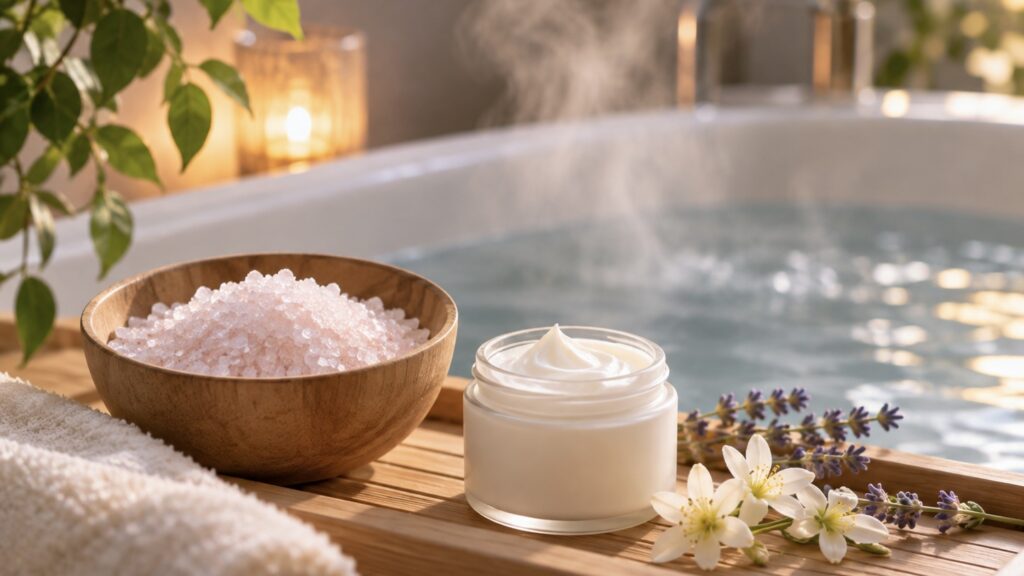
When you want to sleep better, you may find yourself drawn to items that are easy to fit into daily life, such as bath products and body creams.
In recent years, bath products and lotions containing melatonin, a hormone involved in sleep, have been sold overseas.
Melatonin is a hormone whose release in the body increases at night, and it helps regulate the rhythm of sleep and wakefulness.
So when you use a bath product containing melatonin, is the ingredient really absorbed through the skin?
On October 22, 2026, the journal SLEEP Advances published a randomized crossover trial that looked into this question.
The study compared tablets, a lotion and a bath product containing melatonin, and examined how each is taken up by the body.
The results showed a rise in melatonin levels with the lotion, but no clear rise with the bath product.
Here, we explain this new study and the points worth knowing when thinking about the ingredients in bath products.
Melatonin: A Hormone Involved in Sleep and the Body Clock
Melatonin is a hormone released by the pineal gland in the brain.
Our bodies have a body clock that runs on a cycle of about 24 hours, regulating the rhythms of sleep and wakefulness, body temperature, hormone release and more.
Melatonin is closely tied to this body clock.
In general, its release increases at night as the surroundings get dark, and is suppressed when we are exposed to light in the morning.
However, rather than simply being a substance that makes you sleepy, melatonin plays the role of letting the body know that it is nighttime.
Overseas, many kinds of products containing melatonin are sold, including supplements, lotions and bath products.
But a product containing melatonin and the ingredient actually being absorbed into the body are two different matters.
Absorption through the skin in particular depends not only on the properties of the ingredient, but also on the product’s concentration, formulation and how long it is used.
That is why this study examined differences in absorption when melatonin is used in different ways.
A 2026 Study Compared Tablets, a Lotion and a Bath Product
The study published on October 22, 2026, was a randomized crossover trial comparing how melatonin products are taken up by the body.
A crossover trial is a research method in which the same participants try several conditions in turn, and the results are compared.
In this study, 12 people used several melatonin products, and an additional 5 people took part in the bath product test.
The three main methods compared were:
1. Taking it by mouth as a tablet
A method in which melatonin is taken by mouth and absorbed through the digestive tract.
2. Applying a lotion to the skin
A method in which a lotion containing melatonin is applied to the skin to examine absorption through the skin.
3. Soaking in water with a bath product dissolved in it
A method in which a bath product containing melatonin is dissolved in hot water, and mainly the feet and lower legs are soaked for 15 minutes to examine absorption.
The research team measured melatonin levels in saliva for up to 48 hours after use and compared the changes with each method.
What is important here is that the bath test in this study was carried out under conditions different from an ordinary full-body bath.
For that reason, the results cannot simply be applied to every bath product or way of bathing.
No Rise in Levels with the Bath Product, but Absorption Confirmed with the Lotion
What drew attention in this study was that, even with the same melatonin, the way it was taken up by the body differed depending on how it was used.
With the bath product, no clear rise in levels was found
Under the condition using the melatonin bath product, no clear rise was found in salivary melatonin levels.
This means that, at least under the conditions of this test, no measurable absorption was seen.
However, it was not proven that absorption was completely zero.
With the lotion, levels rose within 30 minutes of use
On the other hand, under the condition where melatonin lotion was applied to the skin, salivary melatonin levels rose within 30 minutes of use.
This result suggests that, with a suitable formulation, melatonin may be taken up into the body through the skin.
How long it stayed in the body also differed
Differences were also reported in how long it took for melatonin levels to fall by half.
- Tablets: about 1.2 hours
- Lotion: about 5.7 hours
The lotion showed a value about 4.8 times longer than the tablets.
However, these figures did not directly measure the half-life in the blood, but were assessed from levels in saliva.
Also, staying in the body longer does not in itself mean a greater effect on sleep.
What this study showed is that how melatonin is absorbed and how its levels change differ depending on how the product is used.
An Ingredient in a Bath Product Doesn’t Guarantee an Effect
An important point to take from this study is that ingredients in a product are not necessarily absorbed into the body as expected.
With bath products in particular, the ingredients are dissolved in a large amount of hot water.
That means the conditions, such as the concentration at which the ingredient touches the skin and for how long, are different from a lotion applied directly to the skin.
The skin also has a barrier function that keeps outside substances from getting in.
Not every ingredient can easily pass through the skin.
However, it would also not be right to conclude from this study alone that melatonin bath products are pointless.
There are three main reasons.
1. The study had few participants
This was a relatively small study, and further testing is needed before the results can be generalized.
2. The bathing method differed from an ordinary full-body bath
Mainly the feet and lower legs were soaked for 15 minutes, so the results may not be the same for a full-body bath or a longer soak.
3. The study did not directly examine effects on sleep
What was assessed was mainly the absorption of melatonin and changes in its levels.
The study did not test whether the time to fall asleep, sleep duration or sleep quality improved.
In other words, whether an ingredient is absorbed and whether sleep actually improves need to be considered separately.
Also, because melatonin is regulated differently in Japan than overseas, we do not recommend casually using melatonin products made overseas.
Don’t Think About Bathing for Sleep Only in Terms of Ingredients
This study showed interesting results about the absorption of ingredients in bath products.
However, how comfortable a bath feels and how it affects sleep are not determined by the ingredients in a bath product alone.
Soaking in warm water warms the body, and after the bath, body temperature gradually falls.
This change in body temperature is also linked to how natural sleepiness arises.
In fact, research on warm baths before bed and sleep has reported that warming the body at the right time may be linked to shorter time to fall asleep and other benefits.
For example, a systematic review and meta-analysis published in 2019 showed that a warm bath 1 to 2 hours before bed was linked to falling asleep faster.
However, water that is too hot or a bath that is too long can put a strain on the body.
If you bring bathing into your routine for sleep, it is important to keep it comfortable and sustainable, with a temperature and length that are easy on you.
At La HEAD, too, we value giving you time to step away from busy daily life through warmth, scent and a comfortable treatment.
This study reminds us that when choosing sleep-related products, it is important to check not only what ingredients they contain, but also how those ingredients actually work.
While learning the scientific evidence, let’s find sleep habits that feel good to us.