
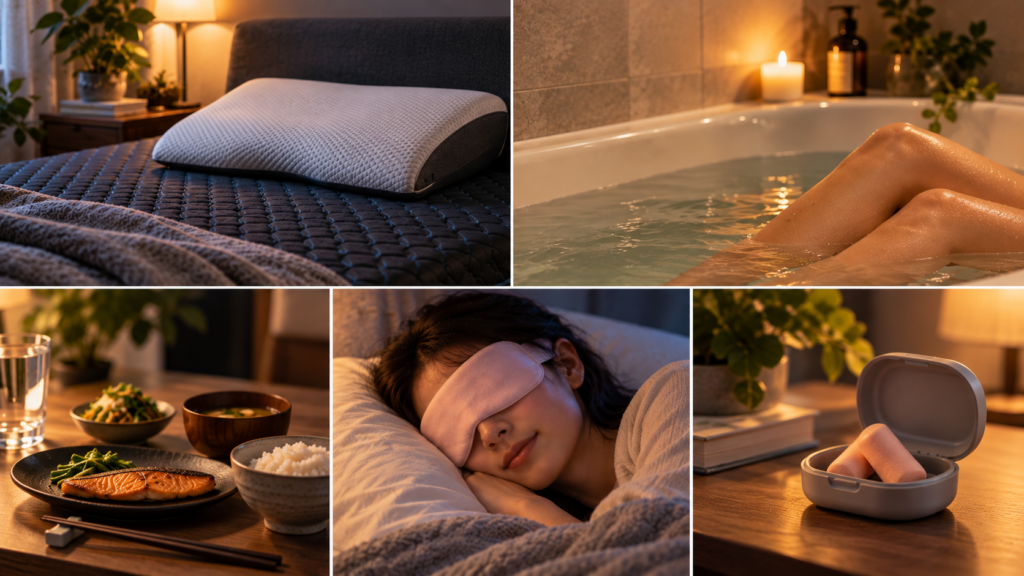
Once you start reading about sleep, the questions just keep coming.
What kind of bedding is best?
What time should I take a bath?
How early should I finish dinner?
What should I do about light and noise in the bedroom?
I’m quite the “sleep enthusiast” myself, and whenever something caught my interest, I tried it out in my own daily life.
Of everything I’ve tried, the ones that have stuck with me as habits are
bedding, half-body baths, dinner timing, a heated eye mask and earplugs
—five habits in all.
In this post, I’ll share the sleep habits I actually keep and why I chose each one.
1. I Use My Bedding Every Night, So I’m Particular About It
If you sleep seven hours a night, you spend about a third of each day on your bedding.
That’s exactly why I take my bedding seriously.
The mattress I use now is the “SX-H Mattress / HARD cp01” from Nishikawa’s [Air Connected] series (Nishikawa is a long-established Japanese bedding maker).
My pillow isn’t an off-the-shelf one, either. It’s custom-made, fitted to my own measured height.
That said, I don’t believe that “the more expensive the bedding, the better you sleep.”
What I care about is that it suits my body, and that it doesn’t get in the way of my posture or natural tossing and turning during sleep.
Mattress firmness and pillow height come down to personal preference and body type.
So rather than choosing based on reputation alone, I try to choose what suits me, as something I use for many hours every night.
2. A 20-Minute Half-Body Bath at 40°C, Two Hours Before Bed
I take a half-body bath at least three times a week.
My basic rule is about 20 minutes at 40°C, roughly two hours before bed.
For bath additives, I love Tsumura’s “Kusuriyu” (a Japanese herbal bath product).
I also love its distinctive herbal scent. Soaking in the tub helps me shift my mind into “the day is done, and now it’s time to rest.”
What I pay attention to here is when I take my bath.
As the body prepares for sleep, its internal temperature, known as “core body temperature,” gradually falls.
A bath warms the body first; then heat escapes through the hands and feet, and core body temperature drops. This change is linked to the natural transition into sleep.
So instead of warming up right before bed, I bathe about two hours beforehand, timing it so my body temperature is falling just as I go to sleep.
3. Dinner at Least Three Hours Before Bed
When it comes to sleep, we tend to focus only on what happens once we get to the bedroom, but I’m also quite mindful of when I eat dinner.
My basic rule is to finish dinner at least three hours before bed.
After a meal, the body gets busy with digestion, absorption and many other processes.
What’s more, recent research has been exploring how not only “what we eat” but also “when we eat” relates to our body clock.
Of course, real life doesn’t always let us eat at exactly the same time every day.
Even so, I avoid eating a lot right before bed and leave some time between dinner and sleep.
For me, this is another part of getting ready for bed.
4. A Heated Eye Mask at Bedtime
This is a habit I’m especially fond of right now.
When I go to bed, I use a heated eye mask to gently warm the area around my eyes.
In fact, there is research on warming the eyes and sleep.
In a randomized controlled trial published in the Journal of Sleep Research in 2025, female workers with mild sleep problems used warming care around the eyes at bedtime for four weeks.
As a result, improvements were seen in falling asleep and in subjective measures of sleep.
Earlier studies have also reported that warming the eyes may raise the temperature of the hands, feet and other extremities, which may help the body release heat.
Of course, this doesn’t mean a heated eye mask will always help you sleep well.
Still, for me the warmth itself feels wonderful, and it has become a kind of nightly switch that says, “Now it’s time to sleep.”
5. Earplugs to Cut Down on Sleep-Disrupting Noise
Last but not least: earplugs.
I don’t use earplugs because I think they will make my sleep deeper.
The purpose is much simpler:
to reduce unnecessary noise that disturbs sleep as much as possible.
A study published in 2026 in the sleep medicine journal SLEEP examined the relationship between nighttime environmental noise and sleep in healthy adults.
When participants were exposed to environmental noise, deep non-REM sleep (N3) decreased.
On the other hand, when they used earplugs, many of the negative effects of noise on sleep were reduced.
In other words, rather than forcing sleep to be deeper, it’s easier to think of earplugs as a tool for reducing the noise that gets in the way of your natural sleep.
They are an easy thing to try if nighttime noise bothers you—especially if you live near a road or railway, in an apartment building, or with family members who keep different hours.
What Remained After Trying So Much: Habits That Aren’t Just About Adding More
When you read about sleep, you come across one appealing sleep gadget or method after another.
I’ve tried many of the ones that caught my interest myself.
But looking back at the five I still keep, they share a common idea:
Creating a flow that makes it easier for the body to fall asleep.
And reducing whatever disturbs sleep as much as possible.
Using bedding that suits me.
Finishing my bath a little while before sleep.
Leaving time between dinner and bedtime.
Warming my eyes.
Cutting out extra noise with earplugs.
Rather than doing one special thing, I think of it as gradually fine-tuning my sleep environment every night.
Of course, this is simply the routine I follow myself, and the same approach won’t suit everyone.
If you’re curious about improving your sleep, there’s no need to change all five things at once.
Just pick one that seems easy to fit into your life and give it a try.
Why not start there and find the sleep habits that work for you?