
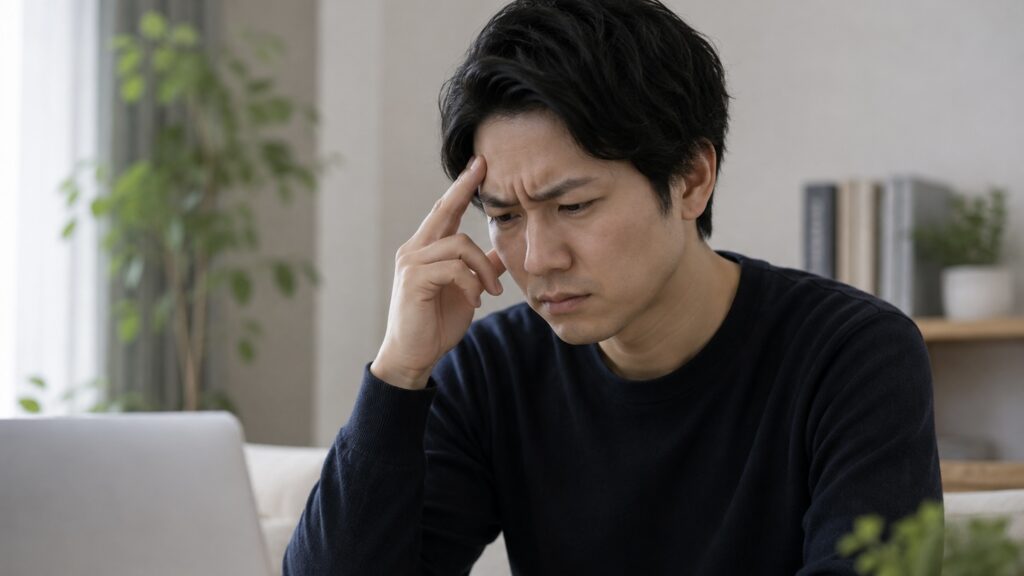
When you’re concentrating on your work.
When you’ve been staring at a computer or smartphone for a long time.
Have you ever suddenly noticed that you were tightly furrowing your brow?
You aren’t angry, and you aren’t in a bad mood.
And yet, as you get tired, your expression naturally turns stern.
In fact, the way you use your eyes, concentration, stress and the “facial muscles” in your face all play a part.
What’s more, even when you’re simply tired, that expression may come across to others as “angry” or “hard to approach.”
This time, let’s take a closer look at the “frown lines” we form without thinking.
What Is the Corrugator Muscle That Creates Frown Lines?
Around the space between your eyebrows is a small facial muscle called the corrugator supercilii.
When the corrugator contracts, it pulls the eyebrows inward and downward, creating vertical lines between them.
It’s easy to understand if you picture an angry or troubled face.
However, the corrugator doesn’t work “only when you’re angry.”
For example, the area between your brows may also tense when you’re trying to focus your eyes on something, such as reading small print or looking carefully at a screen.
And in bright places, you narrow your eyes to reduce the light coming in, which makes the area around your eyes and eyebrows more likely to tense up.
Sometimes, a stern face that appears while you’re absorbed in work has nothing at all to do with your mood.
The Muscles Between Your Brows Also Respond to Stress and Emotion
Even more interesting is the relationship between emotions and facial muscles.
In psychology and neuroscience research, there is a method of measuring even slight activity in the facial muscles using surface electromyography (EMG).
The corrugator is one of the most typical sites measured.
Research has shown that corrugator activity generally tends to increase in response to unpleasant images and stimuli that come with negative emotions.
In other words, our faces don’t move only when we consciously decide to “smile” or “make an angry face.”
Feeling stressed.
Thinking about something difficult.
Concentrating on the task in front of you.
Along with states like these, the activity of your facial muscles can change without your even noticing.
If the area between your brows or your forehead feels tired at the end of the day, you may have been holding tension there for hours.
A Tired Expression Can Look “Angry” to Others
Another thing worth considering is that you aren’t the only one who sees your expression.
When we communicate, we read a great deal of information not only from words but also from the other person’s face.
Depending on the situation, a furrowed brow can serve as a clue for guessing emotions such as anger, displeasure, worry or confusion.
So even if, for you, it was
“I’m just concentrating on my work,”
“my eyes are just tired,”
“I’m just thinking something over,”
just that, the people around you might take it as
“Is something making them angry?”
“They seem to be in a bad mood.”
“Maybe I shouldn’t talk to them right now.”
and read it that way.
Of course, a furrowed brow alone doesn’t decide the impression you make on others.
Still, it’s worth keeping in mind that an expression formed unconsciously out of fatigue or tension can send an unintended message to those around you.
Let “Tension Between Your Brows” Be a Sign to Take a Break
If, while working, you suddenly realize,
“I’m tensing between my brows again,”
it might be a good idea to treat it as a signal from your body to take a break.
Look away from the screen for a moment.
Close your eyes and relax the area between your brows.
Check whether you’re clenching your teeth.
Let your shoulders drop.
Try breathing out slowly.
Even just a short moment is fine.
Rather than forcing only your face to relax, use it as a chance to check whether your eyes, head, neck, shoulders and the rest of your body are holding tension.
At a desk job in particular, your posture tends to stay fixed while you focus on the screen, so it’s important to stand up regularly and shift your gaze into the distance.
To Soften Your Expression, First Let Yourself Rest
When you’re tired, there’s no need to push yourself even harder to “keep smiling.”
What matters is not forcing your expression to change, but turning your attention to the tension within yourself that is creating that expression.
At La HEAD, in a calm, fully private room, we care for not only your head but also your neck, shoulders and arms as one connected whole.
Step away from work and your smartphone, close your eyes, and take a short break from constantly thinking.
We value giving you time to release the tension you usually hold without realizing it.
Before you know it, your brow is furrowed.
On days like that, it may be that not only your face but also your mind and body have been working hard nonstop.
To soften your expression, first give yourself time to let go.
Why not make some time in your busy days to rest slowly without thinking about anything?
We look forward to welcoming you.