
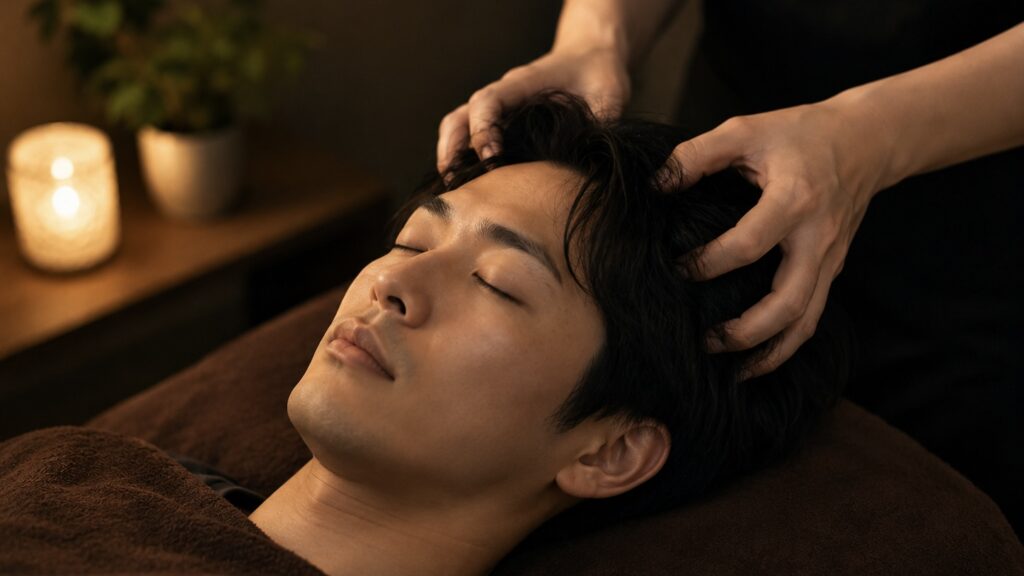
When getting a head massage,
“It would probably work better if they pressed harder.”
“I’m so stiff, maybe I should ask for a firmer massage.”
Have you ever thought this way?
With massage, people sometimes assume that “stronger means more effective.”
However, if relaxation is the goal, stronger is not always better.
Studies of massage pressure and the body’s responses have reported different reactions to light pressure and moderate pressure.
Research comparing “light pressure” and “moderate pressure”
Researchers at institutions such as the Touch Research Institute at the University of Miami School of Medicine in the United States have studied how massage pressure changes the responses of the body and brain.
In studies of adults, massage was divided into
light pressure
and
moderate pressure
, and heart rate and brain waves during the massage were compared.
Massage with moderate pressure was reported to bring about a lower heart rate and brain wave changes thought to be associated with a relaxed yet alert state.
Pressure that only lightly stimulated the surface of the skin, on the other hand, produced responses different from those of moderate pressure.
In other words, from the standpoint of relaxation, simply touching lightly is not enough; a reasonably firm pressure may be what leads to a sense of comfort.
If moderate is good, is stronger even better?
This is where it is easy to go wrong:
“If moderate pressure gave good results, wouldn’t even stronger pressure be better still?”
That is the line of thinking.
But this research does not show that.
What was compared was mainly “light pressure” and “moderate pressure”; these studies did not prove that the more painful the pressure, the greater the relaxation.
If anything, what matters most in massage is how the person receiving it feels.
“It feels good to be pressed firmly”
and
“It hurts, but I’ll put up with it because it must be working”
are not the same kind of stimulation.
If the massage is for relaxation, there is no need to push yourself toward the latter.
Why does “some pressure” feel so good?
In and beneath our skin are many kinds of sensory receptors that detect pressure, vibration, skin movement and more.
When massage applies a certain amount of pressure, this sensory information travels through the nerves to the brain.
Massage research has explored, for example, the possibility that moderate pressure triggers responses associated with parasympathetic nervous activity.
In addition, a 2026 review on massage and brain activity published in the Journal of Clinical Medicine organized a total of 47 studies: 30 using EEG (brain waves), 12 using fMRI and 5 using fNIRS.
Several studies observed increases in alpha waves and decreases in the beta and gamma bands after massage, and researchers are examining how the sensory stimulation of massage relates to the state of the brain.
However, because research methods and types of massage vary widely, we are not yet at the stage of saying that a specific pressure will always produce a specific brain wave pattern.
The “just right” pressure differs from person to person
And something we must not forget in massage is individual difference.
With the same pressure,
“I could take a little more”
is how some people feel, while for others,
“It’s a bit too strong”
is how it feels.
The pressure that feels good depends on the condition of your scalp, neck and shoulders, your body size, how tired you are that day, and how sensitive you are to stimulation to begin with.
Even for the same person, how it feels can vary from day to day.
That is why rather than deciding by numbers that “X kg of pressure is optimal,” it is important to adjust to a pressure at which each person can comfortably let their body go.
Why La HEAD doesn’t aim to “massage hard”
At La HEAD, our goal is not simply to massage the head firmly.
We work carefully not only on the head but also on the neck, shoulders, back of the head and arms, considering how the body is connected and adjusting to each guest’s condition and how they feel.
Rather than enduring strong stimulation,
“You can feel the pressure clearly, yet your body stays relaxed.”
That is the kind of comfort we value.
There is no need to think that “the more it hurts, the better it works.”
Research also points in this direction:
Not too light, not too strong, but a pressure that feels good to you.
To relax with a head massage, rather than focusing on how hard it is, why not focus on whether it is a touch you can trust enough to let your body go?