
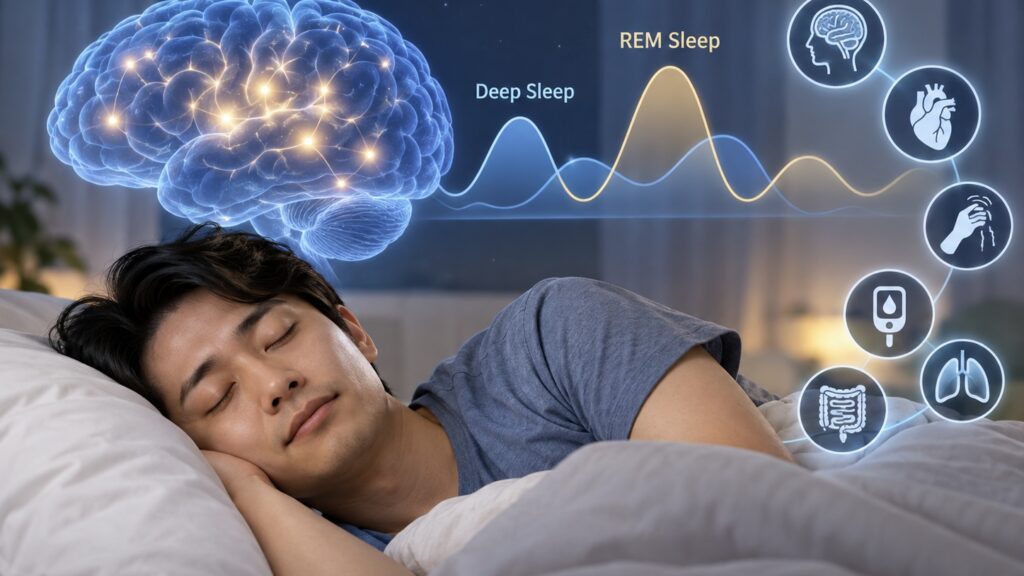
“I sleep well every night, but I still feel tired.” “I should be getting enough sleep, yet I get sleepy during the day.” Have you ever felt this way?
When we think about sleep, we tend to focus on how many hours we slept. Recent research, however, suggests that not only sleep duration, but also what happens during sleep, such as REM sleep and deep sleep, may be linked to health.
On September 17, 2026, the international journal PLOS Medicine published a large-scale study that examined the relationship between sleep data from 95,559 people and their future illnesses.
The study found that people with more REM sleep had a lower risk of 83 diseases, including dementia and heart failure.
Here, based on the results of this study, we explain the link between sleep quality and health, and what to keep in mind in your daily sleep habits.
Is Sleep Only About Hours? The Roles of REM Sleep and Deep Sleep
Sleep is not one unchanging state that lasts from the moment you fall asleep until morning.
During sleep, we cycle repeatedly between REM sleep and non-REM sleep.
REM sleep is a sleep stage in which the body’s muscles are relaxed while parts of the brain are relatively active.
It is known as the stage in which we tend to dream, and it is thought to be involved in processing memories and emotions.
Non-REM sleep, on the other hand, is divided into several stages by depth, and the deepest of these is “deep sleep (N3 sleep).”
In deep sleep, slow, large electrical waves appear in the brain, and this stage is thought to play an important role in physical recovery and memory consolidation.
In other words, sleep is not simply time for the mind to rest, but a complex physiological process in which the brain and body cycle through different kinds of work.
This study examined how these differences between sleep stages relate to the onset of future illnesses.
A New Study That Followed About 95,000 People for 8.9 Years
The study published on September 17, 2026, used data from UK Biobank, a large-scale health study in the United Kingdom.
The participants were 95,559 adults with an average age of 56.2, followed for a median of 8.9 years.
Participants wore an accelerometer on their wrist that recorded sleep-related data in their everyday lives.
The research team analyzed the collected data with an AI technique called “SleepNet” to estimate sleep stages such as REM sleep, deep sleep and light sleep.
They also assessed sleep duration, sleep regularity and time spent awake after falling asleep.
They then matched this with medical records and examined the link between sleep patterns and new cases of 1,049 health conditions and diseases.
The results showed links that met strict statistical criteria between sleep measures and 156 diseases.
What drew particular attention was the length of REM sleep and deep sleep.
However, the sleep stages in this study were not measured directly from brain waves, but estimated by AI from wrist movements. This means there may be some error compared with actual sleep stages.
More REM Sleep Was Linked to a Lower Risk of 83 Diseases
The most interesting results in this study concerned REM sleep.
The research team found that people with more REM sleep had a lower risk of developing 83 diseases across 12 disease categories.
Specifically, for about 47.6 more minutes of estimated REM sleep, the following results were reported:
- • Dementia: about 46% lower hazard of onset
- • Alzheimer’s disease: about 31% lower
- • Heart failure: about 26% lower
- • Atrial fibrillation: about 17% lower
- • Ischemic heart disease: about 13% lower
“Hazard” here is a statistical measure of how likely a disease is to develop during the follow-up period. It does not show the probability of developing the disease itself.
Also, the figure of 47.6 minutes is a comparison range set from the distribution of REM sleep among participants; it does not mean that deliberately adding about 48 minutes would bring the same effect.
Even so, it is an interesting finding that REM sleep was linked not only to dementia, but to many aspects of physical health, including the heart and blood vessels.
REM sleep is thought to be involved in processing memories and emotions, but this study found links with a much wider range of health measures.
However, it has not been proven that REM sleep directly prevents disease.
It is possible that healthier people tend to have more REM sleep, or that sleep structure has already changed in the early stages of an illness.
Deep Sleep and Sleep Regularity Are Also Linked to Health
This study reported interesting results not only for REM sleep, but also for deep sleep.
For about 47.5 more minutes of estimated deep sleep, a lower risk of onset was found for 7 diseases.
Specifically, the results were as follows:
- • Type 2 diabetes: about 11% lower hazard of onset
- • Major depressive disorder: about 14% lower
- • Sleep apnea: about 22% lower
- • Parkinson’s disease: about 30% lower
It was also not the case that the longer you sleep, the better for your health.
The study found a non-linear relationship between sleep duration and 86 diseases.
For 69 of them, the sleep duration with the lowest hazard of onset was concentrated roughly in the range of 6 to 8 hours.
In addition, people with irregular sleep times showed links with conditions such as anxiety disorders and depression.
Spending a long time awake after falling asleep was also linked to some health risks.
These results suggest that multiple factors, including sleep length, sleep stages, regularity and waking during the night, may be linked to health.
However, the finding that people with more deep sleep had fewer illnesses does not prove cause and effect either.
The right amount of REM sleep and deep sleep also varies from person to person, and sleep structure changes with age.
There is no need to make lengthening a particular sleep stage your only goal.
What to Keep in Mind for Healthy Sleep, Starting Today
This study suggested that sleep may be closely linked not only to the brain, but to the health of the whole body.
So what should we keep in mind in daily life?
First, what matters is getting the sleep you need.
The Sleep Guide for Health Promotion 2023 from Japan’s Ministry of Health, Labour and Welfare recommends that adults get the sleep they need, taking individual differences into account, with at least six hours as a guide.
Beyond sleep duration, whether you feel well rested when you wake up in the morning is also an important point.
To build good sleep habits, the following ideas may help:
- • Keep your wake-up time as consistent as possible
This helps keep your daily sleep rhythm stable. - • Get natural light in the morning and during the day
This helps set your body clock and prepares you for sleep at night. - • Include moderate exercise during the day
Regular physical activity is one of the things that support good sleep habits. - • Be careful with bright light and caffeine before bed
It is important to reduce stimulation that keeps you awake at night. - Adjust the temperature, lighting and sound of your bedroom
Aim for an environment that is less likely to disturb your sleep.
However, it has not been proven that these habits will always increase REM sleep or deep sleep.
Also, the sleep stages shown by consumer smartwatches and similar devices are estimates, so there is no need to judge how well you slept by those numbers alone.
If you feel very sleepy during the day even after sleeping long enough, or if you have pauses in breathing during sleep or loud snoring, a sleep disorder may be the cause, so it is important to consult a medical professional.
What is worth noting in this study is that it highlighted the importance of looking not just at how long you sleep, but also at what happens during sleep and how regular it is, when thinking about health.
Sleep is not just time to recover from the day’s fatigue. It is an important daily habit connected to many functions of the brain and body.
For the sake of your future health, too, let’s take a fresh look at our everyday sleep, little by little.