
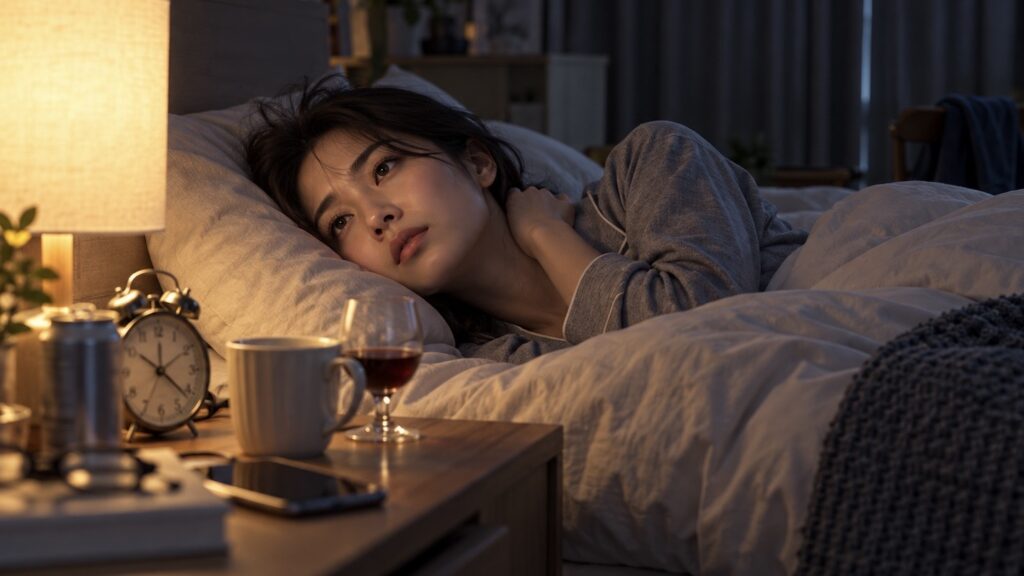
“I’m tired but can’t sleep.” “I wake up many times during the night.” “I wake up too early and can’t get back to sleep.”
Sleep problems like these are not necessarily caused only by tiredness or age. Many factors may be involved, including psychological stress, physical problems and everyday lifestyle habits.
Insomnia is a condition in which, despite having enough opportunity to sleep, difficulty falling asleep or waking during the night continues, and daytime life is also affected.
Recent research has reported that not only the brain’s response to stress, but also physical pain, the body clock, drinking habits and daytime activity are linked to sleep.
Here, based on medical guidelines and clinical research, we explain five common factors involved in insomnia and points to keep in mind in daily life.
Stress, Anxiety and Thoughts You Can’t Switch Off
Mental stress, such as worries about work, relationships or the future, is one of the important factors that disrupt sleep.
Have you ever found that things that didn’t bother you during the day come to mind one after another once it is night and everything is quiet?
When we feel stressed, the brain and body become more alert, which can make it harder to switch into the relaxed state needed for sleep.
In sleep medicine, this mechanism is called “hyperarousal.”
In a study published in the journal Sleep in 2014, the relationship between stress and the onset of insomnia was examined in 2,316 adults with no history of insomnia or depression.
The results showed that people whose sleep was more easily disturbed by stress were more likely to develop insomnia about a year later.
Specifically, the higher a person’s sleep reactivity to stress, the higher the odds of developing insomnia, with an odds ratio of 1.78 for each one standard deviation increase.
A tendency to dwell repeatedly on unpleasant events was also associated with later insomnia.
In other words, it seems that not only how much stress you face, but also how your brain and body respond to stress, matters.
In daily life, making time to step away from work and worries before bed and spending time in a calm environment can help you prepare for sleep.
Physical Pain or Chronic Conditions Disrupting Sleep
Insomnia is not caused by mental issues alone.
Chronic pain such as back pain, joint pain and headaches can also lead to trouble falling asleep and waking during the night.
In a meta-analysis published in Rheumatology in 2023, the relationship between chronic musculoskeletal pain and sleep problems was examined across 20 studies with a total of 208,190 people.
The results showed that people who already had chronic pain had about 2.02 times the odds of later developing new sleep-related problems compared with people without pain.
Conversely, people with sleep problems had about 1.79 times the odds of later developing new chronic musculoskeletal pain.
This shows a two-way relationship, in which pain not only disrupts sleep, but sleep problems are also linked to the onset and worsening of pain.
However, this study also included sleep problems other than insomnia, and it does not prove that pain directly causes insomnia.
Among physical conditions, sleep apnea, restless legs syndrome and respiratory diseases can also disrupt sleep.
If you feel very tired even after sleeping long enough, or if you have loud snoring, pauses in breathing during sleep or discomfort in your legs, it is important to be assessed by a medical professional.
For good sleep, we need to pay attention not only to the sleeping environment, but also to physical problems that may be disrupting sleep.
Irregular Bedtimes and Wake-Up Times
Our sleep is regulated by two systems: the build-up of sleepiness from fatigue, and the body clock, which runs on a cycle of about 24 hours.
This body clock adjusts the timing of sleepiness and wakefulness while being influenced by light, meals, physical activity and more.
That is why, if your wake-up time and bedtime change a lot from day to day, the time you want to sleep can fall out of sync with the rhythm of your body clock.
Night work and shift work in particular are thought to make sleep problems more likely, because the times when the body is active and resting change frequently.
A meta-analysis published in 2026 combined 22 studies and found that people who do shift work had about 1.42 times the odds of sleep disorders overall compared with those who do not, and about 1.22 times the odds when limited to insomnia. That was the association found.
However, these results are mainly based on observational studies, and it cannot be said for certain that shift work itself causes insomnia.
Even people with regular working hours can disrupt their body clock by staying up very late or sleeping in a lot on their days off.
The Sleep Guide for Health Promotion 2023 from Japan’s Ministry of Health, Labour and Welfare also highlights the importance of keeping a regular daily rhythm and getting sunlight in the morning.
Getting up at about the same time every day and being active in bright surroundings during the day are basic habits for keeping your body clock on track.
Nightcaps and Caffeine Disrupting Sleep
Many people enjoy coffee or alcohol every day, but depending on how much and when, they may affect sleep.
First, caffeine.
Caffeine blocks the action of adenosine, a substance involved in sleepiness, and promotes wakefulness.
A meta-analysis of 24 studies published in Sleep Medicine Reviews in 2023 found the following changes with caffeine intake:
• Sleep time shortened by about 45 minutes on average
• Time to fall asleep lengthened by about 9 minutes on average
• Time awake during the night increased by about 12 minutes on average
• Deep sleep decreased by about 11 minutes on average
These are averages combined across experimental conditions, and they do not mean that one cup of coffee will always cost you 45 minutes of sleep.
The effects of caffeine in particular vary with the amount, the time of day and the individual.
Alcohol also needs care.
Some people may feel that alcohol helps them sleep, but falling asleep more easily is not the same as sleeping well.
A meta-analysis of 27 studies published in Sleep Medicine Reviews in 2025 found that even relatively small amounts of alcohol reduced REM sleep, and the effect grew stronger as the amount increased.
REM sleep is a sleep stage thought to be involved in processing memories and emotions.
Alcohol may also increase waking in the second half of the night and worsen sleep apnea.
An important point when thinking about caffeine and alcohol is that something that makes you sleepy is not necessarily good for sleep.
If you have trouble sleeping, it is worth cutting back on caffeine from the evening onward and not relying on a nightcap.
Lack of Exercise and Little Daytime Light
Good sleep depends not only on how you spend your evenings, but also on what you do during the day.
When you spend long hours sitting at a desk and rarely go outside, your physical activity tends to drop and the time you spend in natural light tends to shrink.
A meta-analysis published in Sleep Medicine Reviews in 2024 analyzed data from 19 randomized controlled trials with a total of 1,233 people with insomnia or insomnia symptoms.
The results showed that groups that added exercise had improvements in both subjective sleep ratings and objective sleep measures compared with comparison groups that did not exercise.
However, this study suggests that exercise may help improve insomnia symptoms; it does not prove that lack of exercise directly causes insomnia.
Getting light during the day is also important.
Light is a powerful cue that sets the body clock. In general, morning light tends to shift the body clock earlier, while strong light at night tends to shift it later.
That is why getting natural light in the morning and during the day, and avoiding overly bright lighting at night, helps keep your sleep rhythm on track.
For example, a morning stroll or a light walk at lunchtime lets you get physical activity and sunlight at the same time.
What matters is not forcing yourself into intense exercise, but increasing activities you can keep up in daily life.
Summary: Knowing the Causes of Insomnia Is the First Step to Better Sleep
The five factors introduced here are common ones linked to the onset of insomnia and worsening sleep.
However, they are not ranked by how strongly they cause insomnia, and in reality several factors often overlap.
Also, with insomnia, sleeplessness can continue even after the original stress or physical problem has been resolved.
Anxiety such as “I might not be able to sleep again tonight,” or the very effort of trying to sleep, can increase alertness, so thoughts and behaviors about sleep can keep insomnia going.
For chronic insomnia, cognitive behavioral therapy for insomnia (CBT-I), which reviews thoughts and behaviors related to sleep, is recommended as the first-line treatment in international clinical guidelines.
If sleep problems continue for a long time or affect your daily life, it is also important not to rely only on lifestyle changes, but to consult a medical professional.
Good sleep is not simply about trying to sleep longer.
It is about understanding what is disrupting your sleep, and getting your body, mind and daily habits in order.
Let’s aim for a life where we can sleep comfortably, starting with what feels manageable.