
Birdsong.
The rustle of trees swaying in the wind.
The sound of water flowing somewhere in the distance.
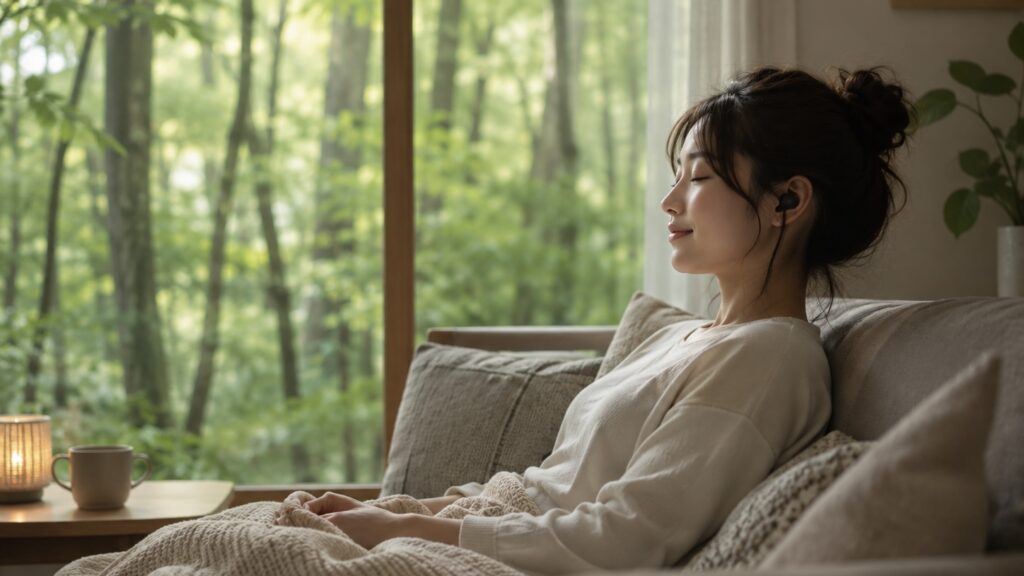
In a forest, simply hearing natural sounds like these can leave you feeling calmer somehow.
So, even without actually going to a forest, can just listening to forest sounds change how we feel?
In recent years, research on how natural environments affect people has looked not only at what we see but also at what we hear.
A 2025 Study Put Forest Sounds to the Test
A study published in the journal Scientific Reports in 2025 examined the differences between listening to sounds from a forest environment and listening to industrial environmental sounds.
The researchers measured not only participants’ subjective mood and sense of recovery but also indicators related to physiological stress responses and the immune system.
They found that, compared with listening to industrial sounds, listening to forest sounds led to more positive changes in mood and the sense of psychological recovery.
In other words, the study suggested that even without a real forest in front of us, the environmental sounds that reach our ears may change how we feel.
Not Everything in the Body Changed
What’s interesting here is that listening to forest sounds did not improve every physiological indicator that was measured.
The study also looked at physical indicators related to stress and immunity, but for some of them, no clear change from forest sounds was found.
So we can’t go so far as to say that
“listening to forest sounds relieves physical stress.”
The evidence doesn’t support that claim.
On the other hand, differences did appear in mood and the sense of psychological recovery.
The findings are also interesting because they show that “feeling pleasant” and “changes in the body’s measurements” are not necessarily the same thing.
We Are Surrounded by Sound All Day Long
If you think back over an ordinary day, you hear far more sounds than you might imagine.
Cars driving by.
Train announcements.
People talking.
Construction noise.
Notification sounds from your computer.
Videos and music playing from your smartphone.
Especially in cities, moments of complete silence may be the exception.
With visual information, it’s easy to notice when we’ve been looking at our phones or using our computers too much, but the information coming in through our ears is surprisingly easy to overlook.
That’s why, when you’re tired, it helps to pay attention not only to what you’re looking at but also to the sounds you’re surrounded by.
When You Take a Break, Try Changing the Sound
When we want a change of pace, we tend to think of doing something, like watching videos, checking social media or going shopping.
But sometimes, simply changing the sounds around you may be enough.
Listen to birdsong or flowing water.
Turn off your smartphone notifications.
Switch off the TV.
Spend just a few minutes somewhere quiet.
The point isn’t that nature sounds will always help you relax; it’s about creating a gentler sound environment than usual and stepping away, even briefly, from the constant stream of stimulation.
If nature sounds aren’t for you, there’s no need to force yourself to play forest recordings.
Choosing sounds you find pleasant, or simply choosing quiet, is another option.
Comfort Isn’t Created by the Treatment Alone
At La HEAD, we value not only the skill of our dry head spa but also the fully private space itself.
Lighting.
Scent.
Sound.
Room temperature.
And being able to close your eyes without worrying about anyone around you.
The moments we find truly comfortable aren’t defined by a single stimulus; they are shaped by many senses working together.
In fact, this study also suggests that the sound environment—what we are hearing—may be linked to our mood and sense of psychological recovery.
Work, commuting, smartphones: everyday life is full of sound and information.
On tiring days, rather than only adding some new stimulation, try stepping away from your usual sounds for a little while.
Listen to the birds, or close your eyes somewhere quiet.
In the middle of a busy life, small moments like these may be an important form of rest.