
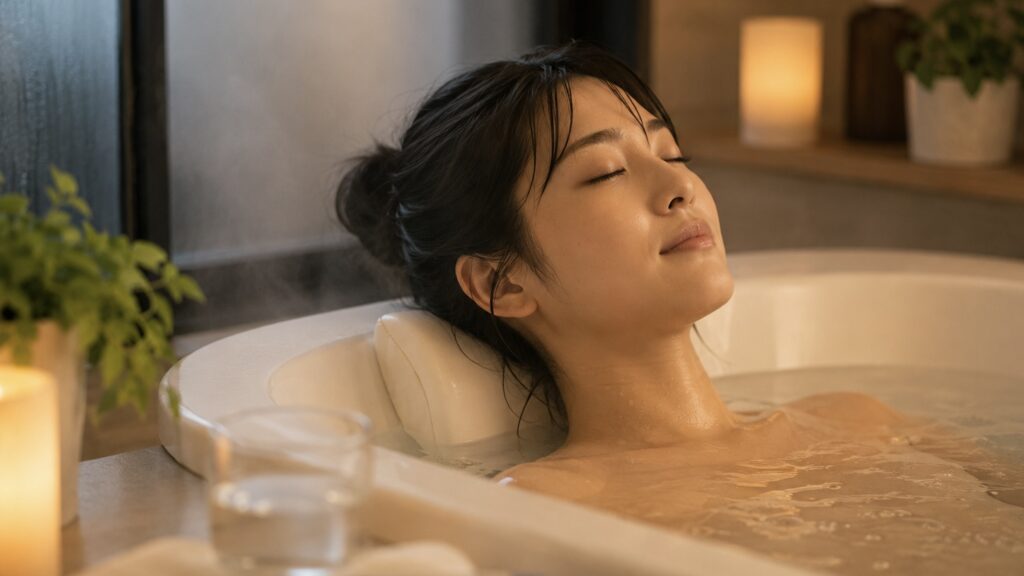
“You have a cold, so you’d better skip the bath today.”
Many people may remember being told this as a child.
In Japan, the idea that “a cold means no bath” has long been widely held.
Today, however, it is not the case that you must avoid bathing whenever you catch a cold.
What matters is not just whether you have a cold, but your overall condition at the time, such as fever and fatigue.
Why was bathing “off limits” with a cold in the past?
In the past, Japanese homes generally lacked the insulation and heating found today, and there was often a big temperature difference between the bathroom and the changing area.
Even if you warmed up in the bath, moving into a cold changing room or living space afterward would chill your body again.
Many families also used public bathhouses (sento), which meant walking home outside after bathing.
Given these living conditions, the habit of avoiding baths when feeling unwell made a certain amount of sense.
Now that homes and bathrooms have changed greatly, however, there is far less need to forbid bathing simply because you have a cold.
What do doctors actually think about bathing with a cold?
In a survey of 269 pediatricians in Japan, 88% of the doctors allowed children with colds to take a bath, according to the report.
In other words, the idea that
having a cold means you must not take a bath
is not an absolute rule even in medical practice today.
However, one thing to be careful about is when you have a fever.
A study found a stronger link with worsening symptoms at 37.5°C and above
A study on bathing conducted in Japan reported interesting findings on body temperature before bathing and changes in condition afterward.
In that study, when body temperature before bathing was 37.5°C or higher, the odds of symptoms worsening after bathing were 16.47 times higher.
Looking at the number alone,
“So taking a bath at 37.5°C is more than 16 times as dangerous?”
you might think, but it is not that simple.
The figure of 16.47 is an odds ratio, not a probability.
In addition, the study subjects and bathing conditions were limited, so it has not been proven that there is a clear line such as
“At 37.5°C or above, you must never take a bath”
“At 37.4°C, it’s safe”.
What we can take from this study is that when you have a fever, bathing may put more strain on your body, so it is wise to be careful.
It is best to treat 37.5°C not as an absolute standard, but as one rough guideline.
An interesting 2026 study on bathing habits and colds
In 2026, a research team including Hamamatsu University School of Medicine also reported a study on bathing habits and upper respiratory tract infections.
In a survey of 1,968 people in total, children aged 3 to 5 and their parents, the researchers found among the children an association between a habit of bathing in water at 39–40°C and fewer upper respiratory tract infections, compared with bathing at 38°C or below.
Among parents, too, a habit of soaking up to the chest or shoulders in water of about 39–40°C for about 7 to 20 minutes was associated with fewer infections.
However, this was an observational study.
That means it has not been proven that
“Taking baths prevents colds”
“Bathing helps you recover from a cold faster”.
Factors other than bathing, such as lifestyle habits, may also have played a role.
The study should be understood only as showing an association between regular, moderate bathing habits and fewer upper respiratory tract infections.
So, can you take a bath with a cold or not?
Based on current research, the rule of thumb is very simple.
Think not about whether you have a cold, but about whether bathing is likely to put a strain on your body.
If you have no fever, feel relatively well, are drinking enough fluids, and have no strong fatigue, chills or dizziness, there is probably no need to avoid bathing just because you have a cold.
If you do take a bath, it is important to avoid very hot water and long soaks, and keep the temperature and time comfortable.
On the other hand, if
you have a fever of 37.5°C or higher
you feel very fatigued
you have strong chills
you feel dizzy or unsteady
you are not drinking enough fluids
then rather than forcing yourself into the tub, it is safer to rest first.
Moving from the old idea that “a cold means absolutely no bath”
to “a mild cold is fine for bathing, but don’t push yourself when you have a fever or strong symptoms.”
That is the shift.
Even with everyday health habits, it is important to decide based on how your body feels that day, rather than relying only on long-held common sense.
*If you have a persistent high fever, difficulty breathing, severe fatigue or cannot keep fluids down, please consult a medical professional rather than deciding only whether to bathe.