
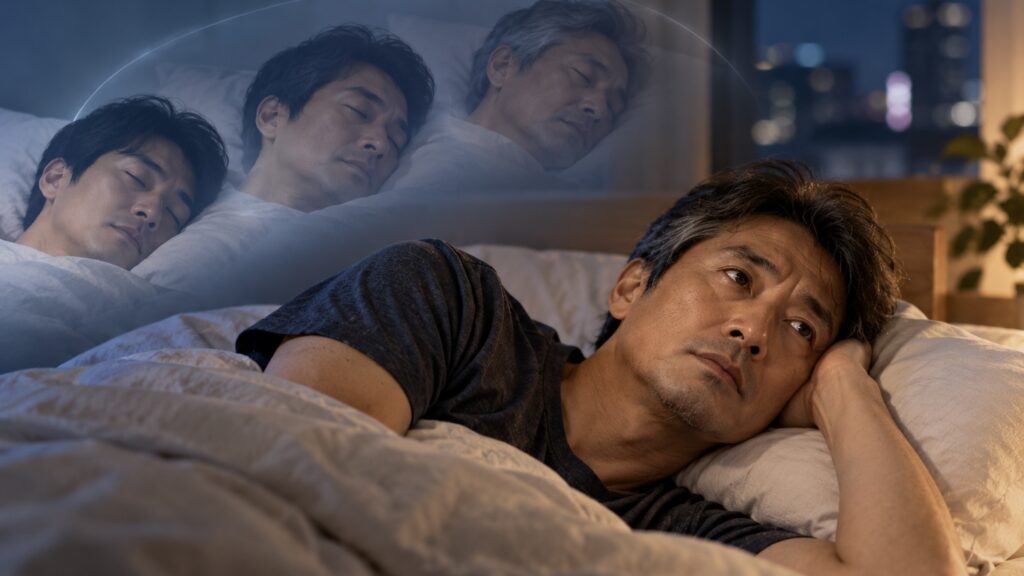
“When I was younger, I could sleep soundly until morning, but lately I keep waking up in the middle of the night.”
“I should have slept long enough, but I don’t feel as deeply rested as I used to.”
Many people notice changes like these in their sleep as they get older.
In fact, sleep tends to become more fragmented with age, and deep sleep changes too.
So why does sleep change as we grow older?
In September 2026, a research team at the University of Pennsylvania published a fascinating study focusing on the molecular-level changes shared by aging and disrupted sleep.
It’s Not Just “I’m Getting Older, So I Can’t Sleep”?
What this study focused on is proteostasis, a system inside our cells.
It may sound like a difficult word, but put simply, it works like a “quality-control system” for keeping the proteins inside our cells in good working order.
Our cells don’t just make proteins; they are constantly folding them correctly, repairing damaged ones, and clearing away those no longer needed.
Keeping this balance is important for cells to continue working properly.
The research team integrated and analyzed gene-expression and protein data from humans and mice to investigate whether the changes caused by aging and those caused by chronic sleep disruption share a common molecular pathway.
A Key Player Called “HSF1”
What emerged from the analysis was a factor involved in proteostasis: HSF1 (Heat Shock Factor 1).
HSF1 is an important factor that regulates the responses that keep proteins in normal condition when cells are under stress.
In this study, using different kinds of data from mouse brains and human blood, changes in HSF1-related proteostasis were confirmed as a feature that appears in both disrupted sleep and aging.
Even more interesting, the findings showed that when acute sleep loss increases the burden on cells, the ability to activate the systems that respond to it tends to weaken with age.
This decline was especially pronounced in neurons.
Disrupted Sleep and Aging May Not Be a “One-Way Street”
This is what makes the study especially interesting.
The findings suggest that it may not simply be a matter of “getting older → sleeping more lightly.” The relationship may be more complex than that.
Age isn’t the only cause. Repeated sleep loss and disrupted sleep may themselves be linked to cellular changes that overlap with those of aging.
The researchers propose a model in which both repeated sleep disruption and aging are linked to a decline in the ability to maintain protein homeostasis.
In other words, it’s not only that aging changes our sleep: the systems involved in disrupted sleep and cellular aging may be connected at the molecular level.
In fact, another 2026 study also found protein changes in the brains of young mice under chronic sleep restriction that resembled those seen in aged mice. The relationship between sleep loss and aging is a topic now being studied from many different angles.
That Doesn’t Mean “Light Sleep = Aging Cells”
It’s important to keep these ideas separate.
This study integrated and analyzed multiple sets of molecular data from humans and mice.
That means it is not a study from which anyone can draw conclusions such as
“I wake up at night because my HSF1 has declined.”
“People who sleep lightly are aging faster.”
The research doesn’t support judgments like these at the individual level.
Also, many factors lie behind the way sleep changes with age, including the body clock, sleep pressure, lifestyle habits, activity levels, and illness or medication.
What makes this study so interesting is that it highlights one of the mechanisms shared by aging and disrupted sleep from the perspective of the cell’s “protein management” ability.
Caring for Your Sleep as You Age
You don’t have to keep the exact same sleep you had when you were young for the rest of your life.
It’s natural for sleep to change with age.
That’s why what matters is not to worry more than necessary that “I can’t sleep the way I used to,” but rather this:
Getting enough sleep, keeping your wake-up and bedtimes fairly consistent, moving your body moderately during the day, and adjusting the light and temperature in your bedroom.
Shaping these basic sleep habits and surroundings to suit who you are now.
“My sleep is lighter because I’m getting older.”
Behind changes we often dismiss with that one phrase, all kinds of changes are happening at the cellular level.
And this study suggests that sleep and aging may be more deeply connected than we think.
Your nightly sleep is more than just time to recover from the day’s fatigue.
The older we get, the more we should value “how we rest” just as much as “how hard we work.”
That’s a mindset worth keeping close.