
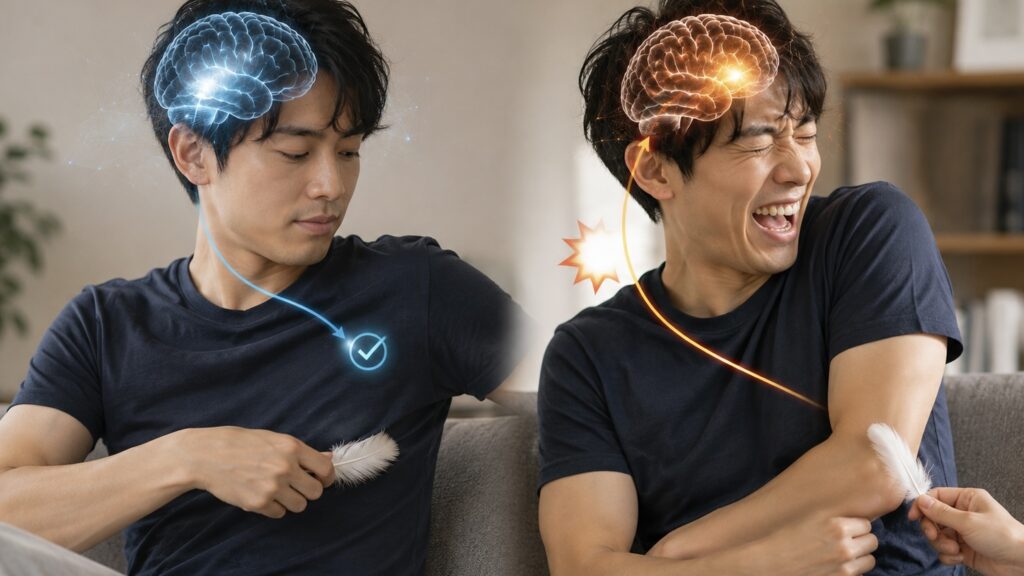
When someone tickles your sides or the soles of your feet, you squirm and burst out laughing before you know it.
Yet when you touch the very same spots with your own hand, it hardly tickles at all.
It’s the same spot.
It’s the same skin being touched.
So why does “touching yourself” feel so different from “being touched by someone else”?
This everyday little puzzle actually reveals a remarkably sophisticated ability built into our brains.
It’s the ability to predict what is about to happen to our own bodies.
Your Brain Predicts the “Next Sensation” Before You Even Move
Try touching your left arm with your right hand.
We don’t have to think,
“I’ll move my right hand exactly this far,”
one step at a time; we simply move our arm naturally.
In that moment, your brain is sending movement commands to your muscles.
But that’s not all it’s doing.
Based on the commands it has just sent out,
“If I make this movement, this is the sensation that should come next.”
it is also thought to be making a prediction like this.
As your right hand approaches your left arm,
where will it touch?
When will it touch?
What kind of sensation will it create?
Your brain predicts the outcome before the sensation actually arrives.
Expected Sensations Feel “Weaker”
This is where a phenomenon called sensory attenuation comes in.
When a sensation caused by your own movement matches what was predicted, the brain may tone down its response to that sensation.
In other words,
You move your own body
↓
Your brain predicts what sensation will follow
↓
The predicted sensation arrives
↓
That sensation is toned down
That is the sequence.
This is thought to be one reason why tickling yourself never feels as intense as being tickled by someone else.
And this mechanism isn’t something special that exists only for tickling.
It is also believed to be important in everyday life, helping us tell apart “sensations we create ourselves” from “sensations coming from the outside world.”
Add a Slight Delay, and You Can Tickle Yourself?
There is a fascinating experiment on this very phenomenon.
In 1998, researchers at University College London and elsewhere studied ticklishness using a device that delivered a touch to the palm in sync with the participant’s own hand movements.
When the timing of the participant’s hand movement matched the moment the touch reached the skin, the sensation felt relatively less ticklish.
But when a time lag was introduced between the movement and the touch, it felt more ticklish.
And when the location of the touch was shifted away from what was expected, the sensation changed as well.
This is a truly intriguing result.
The brain doesn’t simply decide,
“I touched myself, so I’ll weaken the sensation.”
That’s not the whole story.
“When, where and what kind of touch is coming?”
The brain may predict even this much, then compare it with the sensation that actually arrives.
When prediction and reality match, the touch feels weaker.
When the prediction is off, the touch feels more like something “coming from outside.”
Without our ever noticing, the brain is carrying out these fine calculations.
A Touch from Someone Else Can’t Be “Fully Predicted”
So why do we react so strongly when someone else tickles us?
One major difference is predictability.
When you touch yourself, your brain knows
“I’m about to touch.”
It knows this in advance.
But when someone else touches you,
when will it happen?
Where will they touch?
How strong will it be?
How will their fingers move?
Your brain cannot fully predict any of this.
That is why the same touch on the same skin can feel so different.
As the image in this article shows,
Tickling yourself → hardly any reaction
Being tickled by someone else → you can’t help reacting
this is where that difference comes from.
From the very familiar sensation of being “ticklish,” we can see that the brain is constantly predicting the future as it controls the body.
The Sense of Touch Is Deeper Than You Might Think
Once you know how this works in the brain, the act of “being touched by another person” starts to look a little different, too.
When you rub your own head or shoulders, your brain can predict, to some extent, the movements that are about to happen.
When someone else gives you a treatment, on the other hand, you can’t decide for yourself exactly where you’ll be touched next or how much pressure will be applied.
Of course, this doesn’t mean that “massage works better because the touch is unpredictable.”
Research on tickling can’t simply be applied as-is to the effects of massage.
Still, it is fascinating that, for the brain, touching your own body and being touched by someone else are not experienced in quite the same way.
At La HEAD, in a calm, fully private room, we carefully care for not only your head but also your neck, shoulders and arms.
A time to leave yourself in someone else’s hands, a little different from rubbing your own head.
No need to think about where the next soothing touch will come; just close your eyes and relax.
Every day, you keep moving your own body, making your own judgments and deciding your own next step.
That’s exactly why, now and then, you might enjoy some time when you don’t have to do anything at all.
We look forward to welcoming you.