
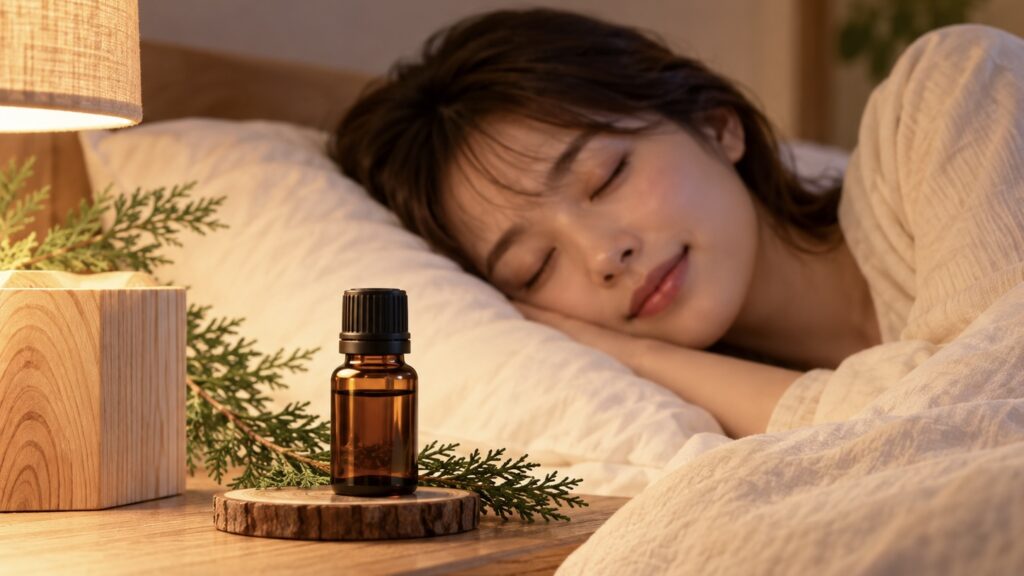
The scent of hinoki, Japanese cypress, has a way of calming you.
It may bring to mind the baths of a traditional Japanese inn, or a walk through the forest.
In 2026, several studies were published looking at how the scent of hinoki affects sleep itself.
We are not yet at the point of saying “hinoki means good sleep,” but interesting changes have been reported in brain waves, night-time awakenings and how people feel on waking.
Here, we look at the link between the scent of hinoki and sleep, focusing on the latest research.
2026: Kyushu University Studies Sleep at Home
In September 2026, a research team led by Associate Professor Kuniyoshi Shimizu of the Faculty of Agriculture at Kyushu University published a study in the Journal of Wood Science on the relationship between sleep and an essential oil extracted from the roots of hinoki grown in Kagawa Prefecture.
The participants were 12 women aged 35 to 60.
At home, the participants spent two weeks each
• using the hinoki root essential oil
• using an unscented control
in what is known as a crossover trial.
Sleep was assessed not only by how participants felt, but in three ways: brain waves (EEG), a smartwatch and a sleep questionnaire. Another feature of the study is that it took place at home, close to everyday life.
Changes in Night-Time Waking and Morning Fatigue
During the period using the hinoki root essential oil, several interesting changes were observed.
On day 7 of use, activity of delta waves, the slow brain waves associated with deep sleep, increased.
And on day 13, night-time awakenings measured by smartwatch decreased, while in the participants’ own ratings,
• sleepiness on waking
• the feeling of recovery from fatigue
both improved.
In other words, in this study, sleep-related changes appeared with repeated use over one to two weeks, rather than immediately after smelling hinoki once.
The researchers suggest that hinoki root essential oil may help with falling asleep, staying asleep and feeling refreshed in the morning.
Another 2026 Study Also Found Better Sleep Quality
In August of the same year, another study on hinoki essential oil was published.
This randomized trial asked 33 healthy men and women aged 65 to 79 to inhale either
• hinoki essential oil
• alpha-pinene, an aromatic compound also found in hinoki
twice a day for four weeks.
In the group using hinoki essential oil, measures of mood improved, along with sleep as assessed by the Athens Insomnia Scale.
However, this study did not include a group that used no scent.
So it cannot be concluded that the hinoki essential oil itself caused the improvement, and larger comparative trials are needed.
Why Does Hinoki Feel So Calming?
Hinoki essential oil contains a variety of aromatic compounds.
In the hinoki root essential oil used in the 2026 Kyushu University study,
alpha-pinene, delta-cadinene, gamma-cadinene and limonene
were among the compounds detected in large amounts.
The link between the scent of hinoki and relaxation has been studied for some time.
In a 2015 study at Chiba University, 13 young women smelled hinoki leaf essential oil for 90 seconds, and activity in the right prefrontal cortex decreased while parasympathetic nervous activity increased. Their own ratings also shifted toward feeling comfortable.
In 2025, a study also reported that aromatic compounds released from interior materials made with Kagawa hinoki may increase parasympathetic nervous activity during rest.
However, feeling relaxed does not necessarily mean you will sleep better.
The psychological comfort and physical responses brought on by a scent should be considered separately from actual sleep at night.
Not Every Kind of Hinoki Will Help You Sleep
While this research is very interesting, there are still points to keep in mind.
The Kyushu University study was a small pilot study of just 12 people, limited to women aged 35 to 60.
What is more, the oil used was not from ordinary hinoki wood or leaves, but an essential oil extracted from the roots of Kagawa hinoki.
Even among commercial hinoki essential oils, the aromatic compounds differ depending on where the tree was grown and whether the oil comes from the leaves, branches, wood or roots.
So it is not appropriate to think that
“any hinoki scent has the same effect on sleep”
“smelling hinoki will cure insomnia.”
Both go beyond what the research shows.
Even so, it is notable that several studies of sleep in people using hinoki essential oil were published in 2026, and that changes were found in objective measures such as brain waves and night-time awakenings.
When thinking about sleep, it is important to look beyond sleep time to
lighting, room temperature, sound, scent and how you spend the time before bed
and to shape the environment of your whole bedroom.
At La HEAD, too, we value not only the treatment itself but creating an environment where your head and body can truly rest, from scent and lighting to a quiet, fully private room.
The scent of hinoki was once simply something that felt calming because it smelled nice.
Now, little by little, science seems to be revealing its connection to sleep.