
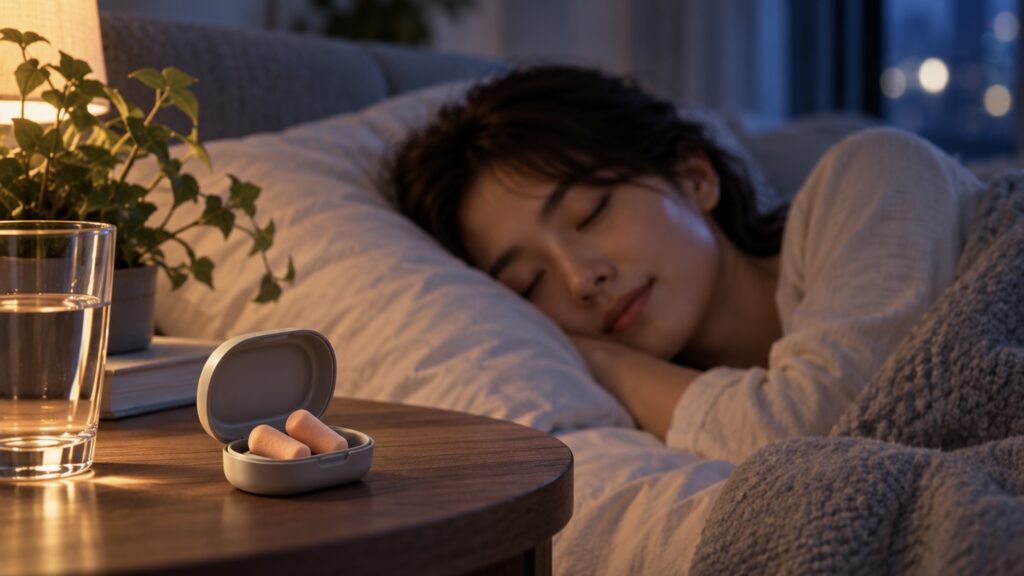
The sound of passing cars.
Voices of people walking outside.
Family members moving around the house.
The hum of the air conditioner and other appliances.
Even if it is not so loud that you cannot sleep, there are surprisingly many sounds in a bedroom.
So if you sleep without noticing them, are those sounds still affecting your sleep?
And is there any point in sleeping with earplugs?
A study published in 2026 in the sleep medicine journal SLEEP looked closely at how nighttime environmental noise affects sleep, and whether earplugs or pink noise can reduce that effect.
Even While We Sleep, the Brain Responds to Sound
When we fall asleep and lose awareness, it feels as if we are completely cut off from the outside world.
However, the sleeping brain does not completely block out stimuli from its surroundings.
For example, a loud noise can suddenly wake us up.
At the same time, even sounds that do not wake us may affect the sleeping brain and the structure of our sleep.
In other words:
“I don’t remember hearing anything” does not necessarily mean “my sleep wasn’t affected.”
Sounds you never noticed can still play a part.
The 2026 Study Found Less Deep Sleep
In this study, 25 healthy adults spent several nights in a sleep laboratory and underwent overnight sleep tests that measured brain waves and other signals.
The research team played environmental noise during the night and analyzed sleep in detail.
The results showed that under noisy conditions, deep non-REM sleep (N3) decreased.
N3 is one of the deepest stages of sleep. It is also called slow-wave sleep, because slow, large waves appear in the brain waves.
This means that even if people do not feel they woke up many times, the sounds around them may change the structure of their sleep.
So What Happens When You Wear Earplugs?
This is where the research team looked at earplugs.
The results were interesting.
When participants wore earplugs, much of the negative effect of environmental noise on sleep was reduced.
What matters here is this:
Earplugs do not make sleep deeper in themselves.
That is the key point.
It is not that wearing earplugs acts directly on the brain to increase deep sleep.
Instead, it is easier to think of it like this:
“Reducing the sounds that disturb sleep protects the sleep you would naturally have.”
Seen this way, the results make more sense.
What Is Pink Noise?
This study looked not only at earplugs but also at pink noise.
Pink noise is a steady, fairly low and gentle-sounding hiss, something like a soft “shhh.”
Some people find it similar to natural sounds such as rain or a waterfall.
A similar sound is white noise, but because pink noise has less energy at higher frequencies, it generally sounds lower and softer than white noise.
Playing a steady sound like this makes sudden noises, such as cars or voices, less noticeable.
This is the idea of “hiding sound with sound,” known as masking.
You may have used it in sleep videos or apps.
Is Removing Sound the Same as Adding Sound?
However, this study also found something unexpected.
Under the pink noise condition, REM sleep decreased.
In other words, it seems we cannot simply say:
“If surrounding noise bothers you, just cover it up with a steady sound.”
It is not quite that simple.
Earplugs reduce the sound coming in from outside.
Pink noise, on the other hand, adds another sound to make the surrounding noise less noticeable.
Both are used to deal with noise, but to the sleeping brain, they may not be the same.
Of course, this study alone is not enough to conclude that pink noise is bad for sleep.
Still, just because a sound is made for sleep does not mean playing it will always help your sleep; this is worth keeping in mind.
Who Might Benefit from Earplugs?
Based on these results, earplugs seem especially worth trying for people who are bothered by noise in the bedroom.
For example, when you live near a road or railway, keep different hours from your family, hear neighbors in an apartment building, or are bothered by noises in a hotel while traveling.
On the other hand, if your bedroom is already quiet and you sleep well, there is no need to force yourself to use earplugs just to improve sleep quality.
Also, earplugs cannot completely block out loud noise.
Rather than a sleep-improvement product, earplugs are better seen as a tool for reducing noise that gets in the way of sleep.
That seems to be the best way to think about them.
Good Sleep Is About Removing Obstacles, Not Adding More
When we want better sleep, we tend to think of things to add, such as:
Buying new bedding.
Taking supplements.
Playing sleep music.
In other words, we often think about adding something.
But when it comes to the sleep environment, the opposite approach matters too.
Reducing light that is too bright.
Adjusting a room that is too hot or too cold.
And reducing unnecessary noise.
This connects with the idea that sleep is scored by deduction, from Professor Masashi Yanagisawa, a leading sleep researcher we introduced before.
Earplugs, too, are not meant to force your sleep to become deeper.
If what disturbs your sleep is sound, simply remove that one obstacle.
Starting with a simple review of your sleep environment like this may be a good first step.
At La HEAD, we will continue to share research on sleep, the brain, and rest in ways that are easy to bring into everyday life.