
“You slept 7 hours 12 minutes.”
“Deep sleep was low.”
“Today’s sleep score: 72.”
With the spread of smartwatches such as the Apple Watch and smart rings, sleep, something we once could only judge by feel, can now be checked as numbers every morning.
It is a very useful feature for looking back on your daily habits.
On the other hand,
“My score is worse than yesterday.”
“I need to get more deep sleep.”
“I absolutely have to sleep eight hours tonight.”
Have you ever found yourself, before you knew it, worrying about the sleep numbers themselves?
In sleep medicine, the term “orthosomnia” has come into use in connection with this kind of excessive preoccupation with sleep data.
What Is “Orthosomnia”?
Orthosomnia is a concept reported in the Journal of Clinical Sleep Medicine in 2017.
The word combines “ortho,” meaning correct or proper, with “sleep,” and describes a state of striving too hard for perfect sleep based on sleep data measured by wearable devices.
You start using a device to improve your sleep, and yet
“I have to get better numbers”
becomes a stronger and stronger feeling, until it actually leads to anxiety and fixation about sleep.
It is a somewhat paradoxical phenomenon.
Note that orthosomnia is not currently an established formal medical diagnosis.
You Felt Well Rested, Until You Saw the Numbers
For example, suppose that when you wake up in the morning,
“I slept really well last night”
is how you feel.
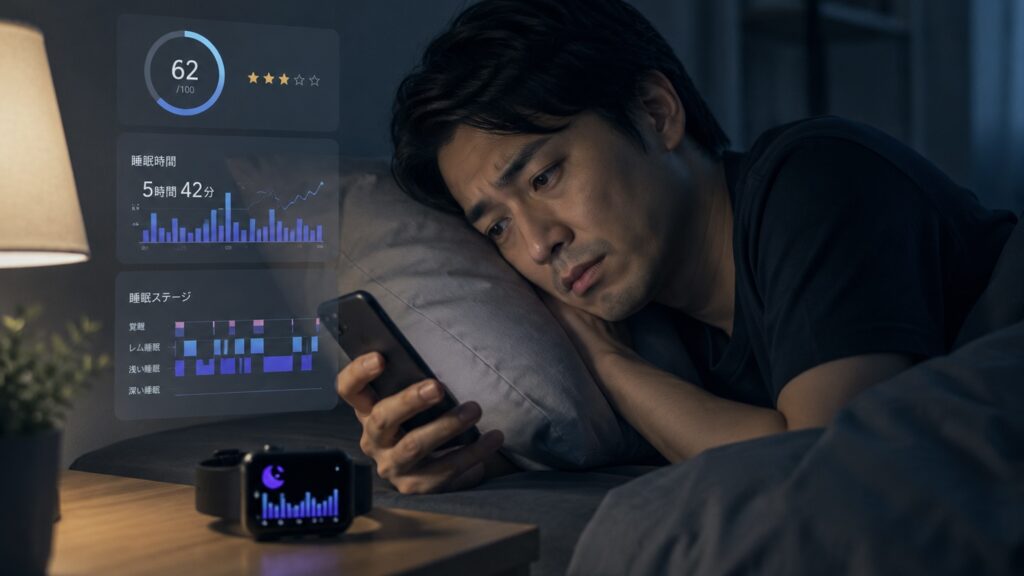
But then you look at your smartwatch:
Sleep score: 62.
Little deep sleep.
Woke up several times during the night.
Suddenly, even though you had been feeling good,
“Maybe I didn’t actually sleep properly?”
is a worry that can creep in.
Then, when night comes,
“I want a better score tonight.”
“I need to fall asleep quickly.”
You become conscious of sleep itself.
Yet the more you treat sleep, which should come naturally, as something you must succeed at, the more it can turn into pressure to fall asleep.
Smartwatches Do Not “See” Your Sleep Directly
What is worth knowing here is that a typical smartwatch is not the same as a sleep study performed at a medical facility.
In a clinical sleep study, sleep is assessed using several kinds of physiological information, such as brain waves, eye movements and muscle activity.
Many wearable devices, on the other hand, estimate sleep time and sleep stages from data such as body movement and heart rate.
The technology keeps improving, but there is no need to treat a figure like “X minutes of deep sleep” as an absolute number that fully captures how you slept each night.
Rather than riding the ups and downs of each night, it is easier to use the data as reference information for seeing long-term trends.
Value How You Feel as Much as the Numbers
When thinking about your sleep, look beyond the numbers on your device to
Did you wake up feeling refreshed?
Are you free of strong sleepiness during the day?
Can you focus on your work?
Is your body free of lingering fatigue?
and other signs of how you yourself feel.
Of course, there is nothing wrong with recording sleep data in itself.
“On nights I stay up late, I sleep less.”
“On days I drink, things look different.”
Insights like these can be a chance to look back on your habits objectively.
What matters is the difference between using data to understand your sleep and letting data judge your sleep.
Sleep Is Not About Scoring 100 Every Night
At La HEAD, in a calm, fully private room, you step away from your smartphone and the information of daily life, close your eyes, and we slowly care for not only your head but also your neck, shoulders and arms.
Being mindful of your health is important.
But precisely because we live in an age when sleep time, step counts, heart rate, calories burned and more about our bodies are turned into numbers, we should not forget the sense of ourselves that numbers alone cannot express.
Sleep is not a test you have to score 100 on every night.
On mornings when you feel you slept well, start by trusting that feeling.
See the data not as the answer, but as one tool for looking back on your life.
And sometimes, step away from your watch and smartphone and make time to rest from the very thought that you must get good sleep.
Now that smartwatches are part of everyday life, why not use them wisely rather than being chased by the numbers, and listen to what your own body is telling you as well?